Category Archives: Uncategorized

Gort Biogas and the Brimstone Cowboys

Brimstone, an archaic term synonymous with sulfur, evokes the acrid odor of sulphur dioxide given off by lightning strikes.

South Galway has had to deal with aftermath of ‘Green’ solutions that have had devastating effects on the environment and the people living here. We have had blanket forestry operations with ‘carte-blanche’ approach and no consideration of the downstream environment. We have had the controversial ‘Derrybrien Windfarm’ and their bullying cowboy attitude – ‘bulldoze it first and ask questions later’ – followed by their complete lack of responsibility or consideration or engagement with the community. And now South Galway has to deal with a similar threat. It’s like those spaghetti westerns and the twang of Ennio Morricone’s – ‘The good, the bad and the ugly’ as those belligerent cowboys roll into town – Is this the Derrybrien sequel then as the Brimstone Cowboys bring their dodgy Biogas plans to town?

The Biogas Plan

The plan is to build a massive mega-Biogas plant 800m from Gort Centre,  10m from the Gort River, in the heart of the Burren lowlands.  Make no mistake – this plant is enormous and feeding it and distributing the output is a cause of huge concern – with Heavy-Goods vehicles (HGV) coming into the Glenbrack Roundabout every few minutes. Then – there’s the smell – This is a silage/slurry treatment plant and despite the best designs on paper – they smell!  The input and output ingredients are toxic and a spill into the river or through the Karst underground network would have devastating effects on Gort River, Coole Park and environs.   If this goes ahead – this is a legacy that Gort will have to live with – goodbye tourism, goodbye nice place to work and live!

Concerns over the developer

Even with the best plans on paper things can go very badly wrong with Biogas plants. The worrying thing is that what we have is a very poor design and a belligerent company that is trying to shoehorn these plans into a reality like the ESB did with Derrybrien. In order to catch a cowboy builder it’s always good to look at previous builds and how they operate.

The Gort Biogas developer is called Sustainable Bio-Energy Limited, and they are a sister company of Connective Energy Holding who developed and run the Glenmore Biogas plant, near Ballybofey, in County Donegal. If we take a quick look at some key facts- it starts to raise the alarm bells (Queue ‘rattlesnake rattle’ in the background )

Due to their atrocious environmental record the Glenmore Biogas Plant was on the EPAs Remedial Action List for a number of years. This was due to several non-compliance’s including not reporting incidents (including incidents that should have been reported to Inland Fisheries board) . The developer will steer the narrative toward ‘teething problems’ of a complex plant but reporting incidents isn’t very complex. So we could then assume that things would be getting better – Bad assumption!
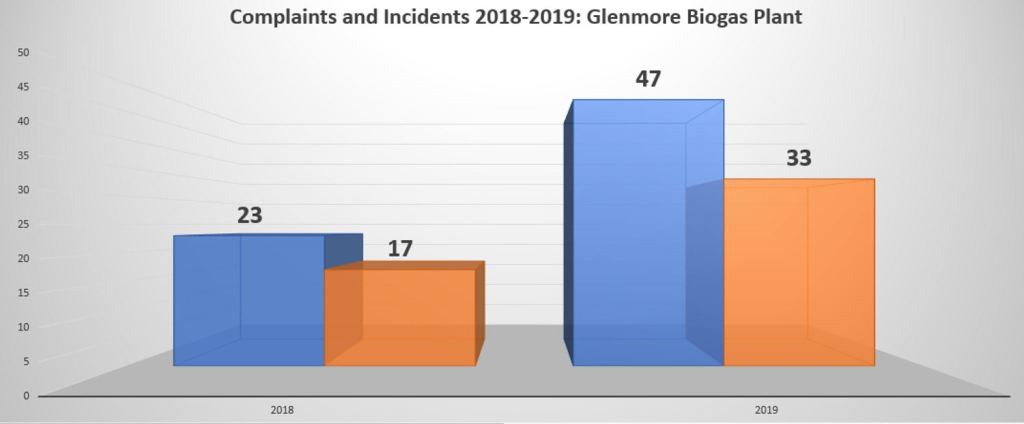
In 2018, there were 23 incidents reported at the Glenmore biogas plant and 17 complaints.   In 2019 these numbers more or less doubled – not a very good trend!  In the case of the 2019 Biogas Plant incidents , the types of incidents are reported below.
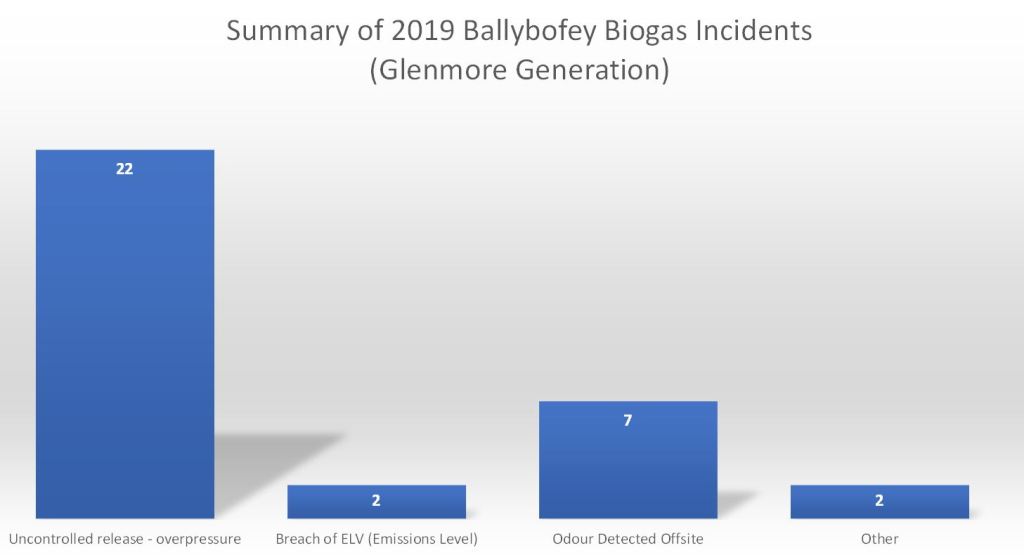
These include uncontrolled release from over-pressure,  breaches of emissions levels, and odour detected offsite.    For more info you can read about it here.

Note: The Gort Biogas Plant is about 3 times bigger than the Ballybofey Plant.

Part of the EPA remedial action was due to the fact that they installed a system that provided 3 times the volume rate defined in their design but they didn’t ‘know’ how much air they were venting because they didn’t install a required flow-metre. When they installed a flow-rate metre – surprise-surprise, they then found out that they were venting far above what they were originally designed for. (Their design defined 13,488m3/hr but it seems this was mistake in their calculations because the building volume (9,053m3) needed to be vented 3 times/hour which was 27,200m3/hr)

So what do they do? – Apply for planning to increase the venting rate!

Let’s recap on this again we have seen here: For Glenmore biogas plant …..

  1. The Design is underspecified but is the basis of the Environmental Impact Assessment
  2. The actual build included installation of machinery that will give the output to regulation (but not as specified in original design). Installation of required flow-rate monitor was not undertaken.
  3. Developerinstalls flow-meter and finds anomaly…
  4. Developer says sorry and applies for permission to increase flow rates

By the time we get to 3, the Biogas plant is built and everything is treated as an increment now. The foot is in the door and this is when we see plant expansions, change of feedstock, and many more things stack up.

Under-design it, assess it, build it, fix it, get permission for it – this could be a genuine mistake or there could be something more nefarious going on (Queue – Vultures circling their prey)

Mistake or Misdirection?

If this was a genuine mistake then surely then they would catch it in subsequent proposals – especially if it was the same company doing the EIAR (Environmental Impact Assessment Report) and applying for permission to increase flow rates.  Nope! It seems that with the Gort Biogas plant there is the same fundamental mistake in their Environmental Impact Assessment.  This isn’t Einstein’s theory of relatively were talking about – its basic pre-junior cert maths:
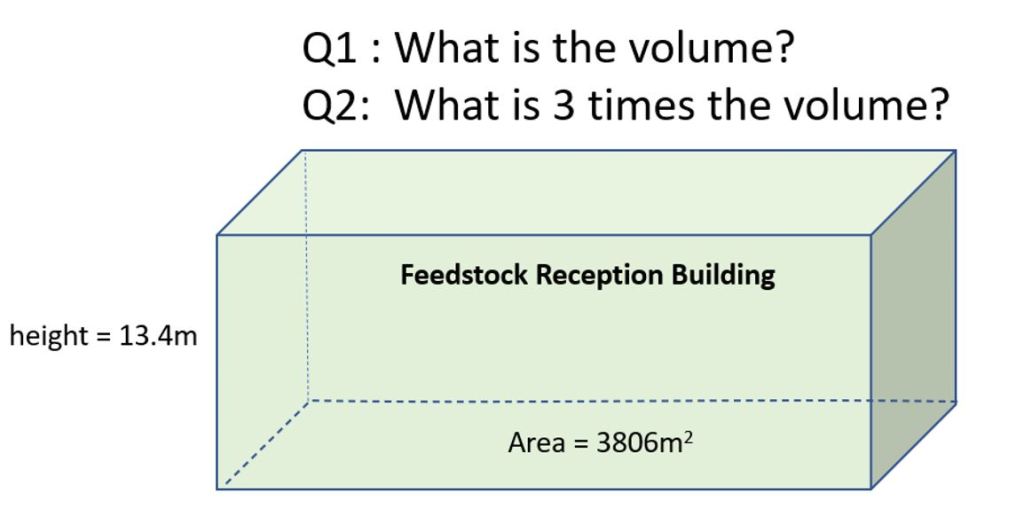
From the EIAR – the total volume of the Feedstock Reception Building is 3,806 m2 x 13.4m = ~51,000m3 . In accordance with regulations, the volumetric emission rate from the Feedstock Reception Building should be three times the building volume so a rate therefore, approximately 150,000 m3 /hour would need to be vented.

In 8.2.3 (Page 8-21)  of their EIAR, the developer states “the volume to be emitted will be ~75,000m3/hour”, in other words – half the required rate. 

Surely, given the ‘trouble’ this caused in the Glenmore Biogas Plant, this basic flaw would have been caught. This metric affects many subsequent assessments (Emissions, odour, air dispersion) in the EIAR so it’s very important in the overall Environmental Assessment and yet – it’s wrong by a factor of 2.

The head hauncho behind the EIAR is Mr Colm Staunton who is a director of Halston and a Project Manager. According to the EIAR, Colm’s experience predominantly relates to Project Management of Environmental Impact Assessments (EIA), Environmental Licensing and Environmental Due Diligence. The example above is one of many flaws in a very poor quality design and EIAR. Mr Staunton has made mistakes in traffic volumes, there are anomalies in Noise assessments, and there are large gaps in the EIAR around the operation of digestate removal. From Mr Staunton’s point of view the spreading of 150,000 tons (7,500 Slurry tanks) of smelly digestate fertilizer ‘in the general area of the site’ should not be a consideration in planning and that it’s just ‘common practice’.

Another flaw that Galway County Council pointed out and requested from Mr Staunton was a public consultation for the proposal to give local feedback. The lack of a public consultation has meant that many assessments were done using ‘desktop’ study and this has produced poorer quality visual,  odour and landscape assessments.  

Note – This is the 2nd time around for EIAR Corrections for Mr Staunton as we pointed out several serious flaws in his last EIAR as well (the application was withdrawn)

In Summary:

So, given the facts, what can we summarize about the Biogas Developers?  You can judge for yourself.

One thing that is really concerning is that, even though the EIAR quality is clearly lacking, there is a belligerence from the developer to push this onto a reluctant community.  It appears that Mr Staunton & Co are not listening -so lets’ be clear once again:

On behalf of the 1000s who signed objections, the 1000s who have voiced their objections and the 400 who submitted objections, please understand that South Galway doesn’t want your dodgy Biogas Plant in our community – now ..  or in the future.    We don’t trust your designs, your plans and your flawed assessments.  We don’t want a repeat of your deteriorating Biogas plant in Ballybofey and don’t want to suffer what the communities there have had to put up with.   Finally, stop trying to bully this community to your will –  Stop with your new applications, your Bord Pleanala appeals and your high-court appeals – you are giving biogas a bad name.

South Galway doesn’t want your dodgy Biogas Plant in our community

The last thing we need in South Galway is another controversy like Derrybrien Windfarms but it should indicate how far our communities are prepared to go to protect ourselves and our environment.

David Murray

Gort BioGas Proposal – Important Community Update

December 2020

Latest developments

In early December, the 400+ people who previously objected against the second attempt at a planning application for a massive biogas plant in Gort received a letter from Galway Co. Co. Following the refusal to grant planning, the Biogas company lodged an appeal with An Bord Pleanala (ABP) in February and in June we heard that the appeal was deemed invalid because it had been lodged too late. Case closed or so we thought.

Since then, the company went to the High Court to contest ABP decision not to deal with the appeal. Their argument related to a discrepancy on the deadline date as reported on the Galway Co. Co website and the ABP website. The High Court ruled in favour of the Biogas company and they now have a second chance to appeal the decision to refuse planning by Galway Co. Co to ABP.

So where does this leave us now……?

Essentially, we’re back to where we were in January 2020 when the application was refused for the first time.

Why did people object in the first place?

There were many many different reasons for the objections which are highlighted in Significant Failings of Gort Biogas Proposal

In summary,

  • The proposed Biogas plant would be the biggest in Ireland and South Galway is not the right location for a plant of this scale. Check out post on Gort Biogas Plant – Location, Location, Location
  • The developers have a very poor reputation and the sister plant in Ballybofey is a cause of grave concern. The proposal and EIA is very poor quality with a lot of deficiencies – we’re asking for trouble if they build it as proposed. They also have a reputation of adding on more silos etc. once they have a footprint.
  • Gort as a place to live and visit, would be impacted. There are big problems with Odour from this site which is only 300m from Gort Town Center. The proposed plant would will bring a heavy increase in HGVs’ through Gort Town centre – these are likely to be slurry tankers. Check out Gort Biogas, Something smells fishy!
  • The plant is within 10m of the Gort River and its connectivity to Coole Lake and environs. This is a tremendously sensitive Area with multiple SACs. Biogas plants have incidents and accidents (The Ballybofey Biogas plant had 43 incidents (that were reported) in 2019, up from 23 in 2018. )

So what happens next and what can we do……?

Once ABP receives a renewed appeal from the Biogas company, we as a community, will have four weeks to lodge our objections. For those who lodged an objection last March to ABP; this can be updated and resent with a new date and a new reference number (we will know this once an appeal is lodged). ABP will also need to take in consideration the 400 objections with Galway Co. Co.

We will update our template objection letters for ABP for those wishing to use these.

The Concern Group will stay very vigilant about what happens next and already started planning our response to a new appeal. Keep up with the latest on our Facebook page.

If you are one of the thousand residents who signed a petition list against this appeal: these lists are in safe hands and we will resubmit them again.

So what can local business do….?

We need your support now more than ever. Have no doubt this development, should it go ahead, will have a significant negative impact on our town and local communities, its long term viability and its ability to grow and prosper. Significant increase in HGV volumes through the town- all day, every day, intense and persistent odours, destruction of our Riverwalk and local environment and our ability to attract tourists are just some of the things we can expect if this facility gets planning approval.

This in turn will impact on businesses within the town. So take an objection template or write your own and join the fight to ensure all of our futures.   

   Gort Biogas Concern Group

Gort Biogas Proposal – Appeal Refused

Since the first planning application in April 2018 the people of Gort have voiced their concerns against the proposed location of the countries largest Biogas plant in the town.

“The groundswell of support generated by the people of the town and surrounding areas galvanised the community in opposition. ” said Ciaran O’ Donnell, a leading member of the Gort Biogas Concerns Group. “Genuine concerns were voiced by the hundreds of people who attended our public meetings throughout the campaign and the legacy such a development would create for Gort.”

O’ Donnell indicated that proposal was a completely unnatural development for South Galway.

“This was not a classic case of NIMBY-ism (Not In My Back Yard) but raised really big concerns and impacts on the environment, health and safety, the economy of the area and its ability to function now and in the future. Impacts on house prices, our tourism potential and future viability as a place where people would want to live.”

The first planning application was withdrawn by the group in December 2018 before a decision could be made by Galway County Council. A second planning application was lodged in late 2019 and through due process was refused by Galway County Council given concerns about the facility and its ability to operate given the supporting information. An appeal was lodged by the developer in February this year with An Bord Pleanala concerning the decision of Galway County Council to not award planning permission.  

Confirmation has been received from An Bord Pleanala that this case has now been closed and so the decision of Galway County Council remains; Planning refused.  

 “As a group and a community, we fully support the decision of Galway County Council and An Bord Pleanala”, said O’ Donnell “We would acknowledge the help and support of those of our elected councillors who supported the campaign throughout. “

The group is now considering the future and is putting the onus on local elected representatives to ensure that only well thought out development projects with long-term viability that benefit the community and not the few ever reach this stage again.  

“The groundswell of support generated by this campaign to protect our community and its environment continues unabated and has evolved into positive projects such as the regeneration of the Gort River Walk trail which was threatened by the proposal

We would like to acknowledge the massive input of time and effort by local people and wider community and I am proud to say that the people of Gort are a force to be reckoned with. People of Gort – we salute you! ” said O’ Donnell.

Significant Failings of Gort Biogas Proposal

An Environmental Impact Assessment is meant to be a bullet proof analysis of a development application, and analysis of potential impacts and mitigations developed.

The EIA Report (EIAR) for the Gort Biogas plant application is not fit-for-purpose. Biogas and Anerobic Digestors are still a relatively young technology but have a history of incidents including, leaks, gas release, smell, fire and explosions. Here in South Galway, Ireland’s largest Biogas Plant is being proposed by a company strongly affiliated with another Biogas plant in Ballybofey in Donegal which has been blacklisted as an EPA Priority enforcement site. This site is with 300m of Gort Town Centre, will be using the main roundabouts to transfer over 200,000 tonnes of material and is within 10m of Gort River and all the associated underground connectivity.

Propping up such a large-scale development with such a low-quality assessment and dodgy track record puts our whole community at risk and is an insult to the community. Luckily there has been a lot of awareness raised on the risk to South Galway’s people and environment and the community at large has rejected this idea.

Here is some more detail on the key failings.

Detailed list of failings of Gort Biogas EIAR.

When somebody give me feedback on this document -they indicated that this analysis left no stone unturned – That unfortunately is not the case. This wasn’t a search for failings or holes in the EIAR for the proposed Biogas application – this was looking at some of the basics and finding issues almost anywhere I looked, in fact, this is not a thorough analysis – I didn’t get time to do that – it’s point out some obvious holes and basic miscalculations or incorrect assumptions.

We are now calling on our local County Councillors to call a motion to exclude further proposals of Biogas plants within proximity of the town.

David Murray

Gort Biogas, Something smells fishy!

The Gort Biogas concerns – “Wake up and smell the roses, slurry” sign in Gort Square – Flor Burke, highlights one of the key concerns around the Biogas plant so close to the town, Glenbrack & Coole Park,

Odour is one of the key concerns that the South Galway communities have regarding the proposed Biogas mega-plant in Gort. Should it really be a concern though? The Current Environment Impact Assessment thinks it won’t be but lets look at how the sister company is performing and Biogas plants in general.

Ballybofey Biogas Plant

The Gort Biogas plant will be the bigger ‘sister plant’ of the Ballybofey plant so it is good to see how these are faring in how they operate – (Hint – it doesn’t look good). Lets take a look at how they are managing (or mismanaging) their odor control. According to the current Gort Biogas EIAR the following are some of the key steps in managing odour.

  • Odour control is done by having negative pressure inside the feedstock area so that foul air (think fish-heads) doesn’t escape. The air extracted from the Feedstock Reception Building will be treated in a Carbon Filter Bed system prior to being exhausted through a 22m high stack. (Note- Positive pressure means the smells escape ‘locally’ without being treated)
  • There will be no emissions to atmosphere from the AD tanks.
  • The combustion of biogas in the CHP Gas Engine will destroy any odorous compounds contained in the biogas prior to being exhausted through another 22m high stack.

Non-complaint Biogas Plant

In Glenmore Biogas Plant in Ballybofey, to keep negative pressure the odour control system was designed to emit 13,488m3/hr at a particular ‘smell’ concentration 1,000 ouE/m3.

From the EPA Report carried out on the Glenmore Biogas Plant in March 2018.

  • There was no flow metre in place to demonstrate the volume being emitted from the order stacks .This has not been in place at any stage since the facility started operating. This is a non-compliance with license.
  • The odour control system was actually installed to emit 27,000 m3/hour, which is over twice the emission limit value specified in the licence. This is a non-compliance with license.
  • Odour monitoring carried out in September 2017 demonstrated a non-compliance (1,261 Oug/m3) with the emission limit value specified in the license of 1,000 Oug/m3 for odour. This is a non-compliance with license.
  • The odour test programme required by licence had not been completed to date despite the licence requiring that this be done within three months of the commencement of operation of the abatement equipment. This is a non-compliance with license.
  • The requirement to demonstrate negative pressure and reception building envelope integrity not been achieved. This is a non-compliance with license.
  • A programme for the identification and reduction of fugitive emissions has not been prepared. This is a non-compliance with license.

There are a number of observations to be made here.

  1. The requirements for keeping negative pressure in the feedstock (e.g. fish-heads) are were under engineered i.e. 13,488m3/hr at a particular ‘smell’ concentration 1,000 ouE/m3. They now say they need twice that.
  2. Without any planning or analysis, they installed a system that spewed out twice the volume/hour and even then, they were still at times going 20% over their limit of 1,000 ouE/m3.
  3. Even then, they could not demonstrate that they had negative pressure in the reception buildings.
  4. There were over 20 ‘official’ complaints of odour in 2017 – with July 2017 getting almost half the complaints. This was supported by official odour testing confirming that Odours exceeded licence parameters.
  5. There are many local stories of bad smells in the area coming from the biogas plant including a school that had to keep its pupils indoor due to the smells.

From the start, the odour control of the Glenmore plant has never been EPA compliant, in fact it breaks many aspects of EPA license on odour and it looks as if it is having an impact on the community

The Glenmore Biogas plant and the proposed Gort Biogas plant reeks of poor design and boilerplate EIA checkboxing – It’s obvious that not only do these analysis and proposals not work and that they then need to be redesigned – but at what cost and impact to local community.

This EIAR is flawed and so too are the checks and balances that supposedly protect us. The Glenmore Biogas plant’s has been non-compliant since commission and obviously has odour problems and their get-out-of-jail card is to apply for a license to pump more smelly air into the atmosphere – with the same faulty analysis as before.

Odour, Odour Everywhere!

According to report by Bioenergy research, 11 Biogas plants were studied and found to have had odour complaints. A summary of these is listed here:

biogas_smells

Considering the addition of potentially 3-4 times the amount of digistate being added to lands in the vicinity of the plant this would have a significant impact on the smells and the welfare of people and tourists coming into the area.

Biogas Leakages

According to a very recent article – Over the last 8 year Over the last eight years, 85% of the 964 plants surveyed by FM BioEnergy in the UK and Germany were suffering from biogas leakage. [1]

  • A quarter of these were deemed ‘significant’ in terms of their leakage (>1,000l CH4/h), causing serious safety concerns and financial losses.
  • Half of them had only minor leakages (< 100l CH4/h) while
  • The rest were deemed ‘medium’ (< 1,000l CH4/h). In most cases, more than one type of leakage was present.

That’s over 20% of surveyed biogas plants, over 200 of them are spewing out 1,000 litres of methane an hour in leaks. This doesn’t bode well for a Biogas developments with a poor trackrecord.

Impacts

The report highlights two impacts

Aside from the considerable environmental impact, biogas leaks bring other risks. In the worst-case scenario, biogas in combination with air can form an explosive gas mixture which, in a confined space near an ignition source, can result in explosion. While explosions are extremely rare, they bring a high risk of serious injuries and fatalities and, as a result, are something no plant owner ever wants to experience on their site.

Biogas also contains hydrogen sulphide (H2S), a toxic gas which has been the cause of several deaths in the UK agricultural industry in relation to slurry tank management. As H2S is heavier than air, it will fall to the ground. In confined, poorly ventilated spaces it can accumulate and remain unnoticed until someone enters, resulting in sometimes fatal effects. 

[1] https://www.filtsep.com/power-generation/features/reducing-the-risk-of-biogas-leakage/

Conclusion

The impacts of poor air quality would have a devastating affect on this area.

While it has an ‘agricultural’ tag – Biogas are chemical plants that produce harmful byproducts. Even with huge amounts of experience – the UK and Germany are struggling to engineer good Biogas plants and globally there are more accidents happening more frequently. There is little doubt that Biogas need to be designed and run by experts, otherwise the results can be catastropic and fatal. When it comes to odour management, the results may not be fatal to humans but can be fatal to a fledgling local rural economy that is hoping to make it’s presence known as part of a Wild Atlantic Way spur and as a great place to work, live and visit. Just looking at the track record of the Sister company Glenmore Biogas in Ballybofey is nerve-racking and their substandard Environemental Impact Assessment Report is a warning bell that South Galway will become yet another Guinea-pig for an flawed ‘Green’ solution – to its detriment.

Please , for the sake of your local community, lodge an objection with Galway County Council or come along to Sullivan’s Hotel from 7pm-9pm Thu 2nd January, to sign an objection letter and stop our community being subjected to this threat, once and for all.

David Murray

Gort Biogas Plant – Location, Location, Location

One of the first main reactions the people (and Galway County Council) have had to the proposed BioGas Plant in Gort  is ‘Why on earth is it being proposed here?’   There are a number of themes emerging around this.

  • South Galway is a very scenic area and has huge potential for tourism growth so why threaten this with dodgy smelly Biogas plant (See Track Record)
  • South Galway/North Clare is a unique area with one of the highest concentrations of SACs in Ireland so why build a plant that could devastate these areas?
  • South Galway is prone to unpredictable and devastating flooding, that seems to be increasing in frequency and severity – Why on earth would you then build a Biogas plant within 10m of the Gort River?
  • This development significantly contradicts the Gort Local Area Plan 2013-2109 so why should it be allowed to proceed?

Location, Location, Location

Biogas plans are supposed to be close to feedstock source as well as having a suitable land bank to spread the digestate end product (akin to slurry). The Gort Biogas Environmetal Impact Assessment Report (EIAR) indicates that there is a lot of unsuitable land for feedstock supply and digestate removal in summary.

biogas_location3

Unsuitable areas for the biogas plan

If we superimpose unsuitable land SACs, SPAS and flooding we get something like this.

biogas_location4

The dark green is where the potential source for feedstock and target for digestate – The Red Cross in the middle is where they want to build the proposed Gort Biogas plant right in the middle of unsuitable land, Special Areas of Conservation, and flood plains!

So what is the justification of locating the Biogas plant in this area seeing S South Galway/North Clare doesn’t have the highest concentration of cattle.  According to Table 2.3 the estimated volume of slurry arising from this total area in the circle is 471,361M3. From this map most of this would be in the  areas north and south of the catchment zone shown.   According to Table 2.2, of the total land within the 30k radius,  11% of it is within the 10k zone. If we average out slurry estimations, the area within 10km of the plant would be generating over 47,000 tons of slurry.  The EIAR (VOLUME 2) states “The biodegradable feedstocks will primarily comprise grass silage and organic farm-based residues such as animal slurry which will be sourced from farms in the vicinity of the plant.   As part of feedstock supply arrangements with local farmers, digestate will be delivered back to the local farms, thereby recycling nutrients to agricultural lands.”

If digestate is disposed of in the vicinity of the plant (10K)  then while this area normally caters for 47,000 tons of slurry, it may now have to contend with a tonnage exceeding 150,000 tons (120,000 tons of digestate and slurry) .   The bottom line is that while feedstock may come from various locations the digestate could be concentrated heavily within the 10km radius and this could have significant impacts on overlying areas.  This analysis has not been done as part of the EIAR.

The referenced EIAR only offers alternate locations around Gort – Why? Why not in farm-rich communities that have more concentration of pasture-land and lifestock.

This proposed location of the Biogas plant is unsuitable and no reaonable alternatives have been proposed -therefore this application should be refused.

Misalignment to Gort Local Area Plan 2013-2019:

The Gort Local Area plan outline a strategy for development ( http://www.galway.ie/en/media/Gort%20Local%20Area%20Plan%202013-2019.pdf) and is a land use plan and overall strategy for the development of Gort.  In general, it helps to guide the local authority and permit development where it is satisfied that the suggested form of development will be compatible with the policies and objectives for the specific zones.

The proposed site is not in the Local Area Plan and is currently zoned for agricultural use and therefore it not compatible with the LAP.  The site however does have an impact on Gort’s objectives. The following is a reasonable assessment on how the BioGas plant impacts the Gort LAP Strategy.

Guiding Principles Biogas plant Impact Comment
Realising the town’s potential as a „Key Town‟ as set out in the Galway County Development Plan and attracting and planning for the population target established in the Core Strategy up to 2015 and beyond. Very Negative Feedstocks, digistate,  smells and additional traffic is not generally seen as something that attracts population
Reflecting the needs and aspirations of local communities, businesses and other interested and affected groups, as expressed through the public consultation process. Very Negative The Local community clearly doesn’t want a biogas plant in this location as was seen by an attendance of 300 people at a public meeting in December 2019
Promoting sustainable land use and transport by capitalising on the opportunity presented by the delivery of the new M18 Gort to Crusheen motorway, the Ennis-Athenry section of the Western Rail Corridor so that sustainable travel, including walking and cycling, and integrated land use and transportation become central to the development of new neighbourhoods and the future development of Gort. Very Negative Current walking routes (unaddressed by EIAR) will be impacted by Biogas plant.  Additional HGVs coming through town increase risk of accidents and will not promote walking/cycling safely around Gort
Maintaining a strong and vibrant town centre that sustains the ability to attract new businesses and meets the retailing and service needs of the town and its surrounding hinterland, in addition to offering a pleasant and attractive environment for shopping, business, recreation and living. Very Negative Biogas plant, flares, steam etc and potential 100+ HGVs a day does not promote attractive environment for shopping, business and recreational living
Facilitating the provision of a range of facilities, amenities and supporting services to serve the needs of the town, including educational, recreational, religious, social, community and civic requirements for children, youths, adults and the elderly. Very Negative Biogas plant does not offer any services, needs here. The plant is purely for profit and not the needs of the community
Fostering economic development and employment creation by optimising the potential of the town‟s strategic location and enhancing Gort as a place of employment through the provision of a positive and flexible framework for the creation of new employment opportunities. Negative A site of 22 acres close to Gort providing just a handful jobs is a tactical and not a strategic result
Supporting the delivery of support infrastructure necessary to facilitate the future growth and sustainable development of the town. Very Negative Biogas plant will add additional pressure on infrastructure.  Water requirements are missing.
Promoting strong community spirit, social inclusion, civic pride and local identity for the town within the broader rural area surrounding Gort. Very Negative Local community doesn’t want Gort associated with Slurry and industrial plant
Protecting and enhancing the heritage and character of Gort including the natural assets, environment, built heritage, public realm, local character and amenity, for the benefit of current and future generations. Very Negative Biogas plant does not offer any heritage aspects, doesn’t add to local character and is not beneficial for future generations

The LAP also calls out the Tourism potential

“Tourism is an important element of Gort‟s local economy and is a sector that has the potential for further growth. The cultural, built and natural heritage of the town and significant local tourist amenities such as Coole Park, Thoor Ballylee, Kilmacduagh monastic settlement and the town‟s proximity to the Burren are important tourist attractions and opportunities for further tourism development, which in turn can help to ensure the appropriate management and protection of Gort‟s local heritage and amenities.”

As part of the Economic Objective ED4:

Tourism Development (refer to Maps 2A/2B) Encourage and facilitate the sustainable development of the tourism potential of Gort and its environs in a manner that respects, builds on, protects and enhances the cultural, built and natural heritage of the town and the local amenities within the Plan Area. Key projects and initiatives that will be supported will include:

  1. Support the sustainable development of a river walkway and a linear park including recreational facilities and activities that will benefit the local community and visitors to the area and enhance the tourism infrastructure in an environmentally sustainable manner that recognises the Water Framework Directive, water quality and Natura 2000 conservation management objectives for the Coole-Garryland Complex and associated protected species including otter and bat species.
  2. Investigate the provision of a tourist/information centre within the town centre.


GortLocalAreaPlan2013

The maps show a Riverwalk titled ‘Provide a walkway along the Kinincha and Pound Road’ (TI24)

  • Objective TI 24– Walkways (refer to Specific Objectives Maps 2A/2B) Provide a walkway along the Cannahowna/Gort River including the Kinincha and Pound Road in a sustainable manner where possible. Regard should be had to the protection of Otters and Otter breeding sites and resting places along the proposed river walk.Comment : Local community (Gort River Walk Development Group) has met with Galway County Council to progressing a Gort River Walk proposal and has received funding for phase 1 on the Lavally side. The   Proposed Biogas plant is a new development that will not promote or prioritise walking. The proposed Biogas plant, potential smells, noises,  and associated HGVs will have a significant impact on this objective.
  • Objective TI4 – Walking : Facilitate the improvement of the pedestrian environment and network so that it is safe and accessible to all through the provision of the necessary infrastructure such as footpaths, lighting, pedestrian crossings, traffic calmed streets etc. New developments shall promote and prioritise walking, shall be permeable, adequately linked and connected to neighbouring areas, the town centre and train station, recreational, educational and employment destinations and shall adhere to the principles contained within the national policy document Smarter Travel: A Sustainable Transport Future – A New Transport Policy for Ireland 2009-2020 (and any updated/superseding document). Galway County Council will ensure that new lighting in sensitive areas, such as close to water-bodies or stands of broadleaved trees, will be sensitively designed so as to avoid impacts on foraging bats and other nocturnal wildlife.

Comment : Local community has Proposed Biogas plant is a new development that will not promote or prioritise walking. It will detract from it and as such is at odds with this objective.

  • Objective TI5 – Cycling Facilitate the improvement of the cycling environment and network so that it is safe and accessible through adequate traffic management and the provision of the necessary infrastructure, such as surface treatment, junction treatment, traffic calmed streets, cycle track/s, cycle lane/s, lighting, road crossings, etc. New developments shall promote and prioritise cycling, shall be permeable, adequately linked and connected to neighbouring areas, the town centre and train station, recreational, educational and employment destinations and shall adhere to the principles contained within the national policy documents Smarter Travel: A Sustainable Transport Future – A New Transport Policy for Ireland 2009-2020 and the National Cycle Policy Framework 2009-2020 (and any updated/superseding documents).

Comment : Proposed Biogas plant is a new development that will not promote or prioritise cycling. It will detract from it and as such is at odds with this objective.

Objective UI7 – The Cannahowna/Gort River and Drainage Catchment (refer to Specific Objectives Maps 2A/2B) Require new development proposals within the catchment of the Cannahowna/Gort River or that potentially drain towards this river to include full details of proposals to address the high probability of flooding associated with the river and its catchment and the need to provide adequate surface water drainage, including the incorporation of Sustainable Drainage Systems.

Comment : As shown the CFRAMS reports have self-assessd themselves as having low-confidence in predicting effects downstream from Gort Bridge.  The proposed Biogas plant is a new development has not addressed this adequately.

This proposal greatly contradicts the objectives in the Gort Local Area development plan and therefore the application should be rejected.

Odour!

The impacts of poor air quality would have a devastating affect on this area.According to report by Bioenergy research, 11 Biogas plants were studied and found to have had odour complaints.

biogas_smells

Considering the addition of potentially 3-4 times the amount of digistate being added to lands in the vicinity of the plant this would have a significant impact on the smells and the welfare of people and tourists coming into the area.

https://www.google.com/search?client=firefox-b-d&q=does+biogas+smell

Track Record

The current biogas plants run by Glenmore Estates in Donegal has come under continusus scrutiny from the EPA due to non-complainces. Section 2.12 of EPA Site visit Report (Site visit reference number SV15392)

Odour sampling and analysis carried out in September 2017 on the Odour Control Stack A2-2 demonstrated a non-compliance (1,261 Oug/m3) with the emission limit value specified in the licence of 1,000 Oug/m3 for odour. This was not notified as an incident to the Agency.

Surface water monitoring results from January and February 2018 show elevated levels of parameters such as BOD and Ammonia which indicate the potential for environmental contamination of surface water. These results were not notified as incidents to the Agency, the Local Authority, Irish Water nor Inland Fisheries Ireland.

In fact, there has been so many non-complainces that Glenmore Estates has made it onto EPA’s National Priority Sites List for Enforcement

Glenmore Biogas Limited, Donegal has been identified by EPA as one of the National Priority Site for Enforcement for failing to meet the necessary environmental standards.

This kind of non-compliance could be devestating for the region and yet this plant went through similar EIAR process which doesn’t seem to guarauntee the level of due-diligence that is needed to ensure there are no unexpected impacts.  The lack of response to these EIARS is highly concerning.


BOOM!

According to the study ‘Analysis of accidents in biogas production and upgrading’, by Valeria Casson Moreno

Biogas industry is experiencing a fast growth worldwide, and biogas production is constantly increasing. However, the number of accidents in biogas production is growing even faster.

The paper states that the study results are  ‘an early warning concerning the major accidents hazard in biogas industry and rose the concern about the need of improving the safety culture and risk awareness in this sector, also by developing and adopting appropriate and specific safety standards.’


biogas_incidents

Classification of Accidents in Biogas Plants, Valeria Casson Moreno

Given the current track record of the company behind the Gort Biogas Plant, there are significant concerns here.

Sensitivity

This area is very vulnerable to environmental incidents.  The Derrybrien windfarm produced a below-standard EIAR and proceeded with development that caused an environmental disaster of the Derrybrien landslide.  The ESB and Irish Government were subsequently charged by European Court of Justice.  The local community was highly active in this case and sees very similar dynamics with this development. The fact that the Biogas plant is in the middle of unpredictable flood plain and so close to the Gort River and its underground connectivity with several SACs, means that if any impacts is not 100% proven to be fully mitigated, the precautionary principle of the Habitats Directive mandates that the development should not proceed.

The current EIAR is not fit for purpose here with blatant holes, gaps, incorrect assumptions and lack of clear analsysis mandates that the application must be refused.

David Murray


Gort Biogas EIA not fit for purpose

When doing a bit of deep diving of the more recent Environmetal Impact assessment Report (EIAR) of the biogas plant – we found  so many holes in that its not even fit for recycling!   There are many questions but surely that’s the purpose of this EIAR – to answer the questions.  There are too many ‘average’ scenarios, inconsistencies, invalid assumptions that make this EIA fit for the bin.  Here are some examples of some of the analysis.

  • Water Requirements – The biogas plant could require a water supply equivalent to over 5000 people, however –  none was requested.
  • Traffic Analysis could be 5 times more than what is predicted
  • Flooding – This is unpredictable yet plant wants to go ahead just 10m from Gort River.


Water Requirements

In water requirements in section 1.3 of Stormwater report 1.3 states “For anaerobic digestion to take place, the digestate must have a dry matter concentration of just 5%-8%, and therefore there will be a demand for up to 120,000m3 of liquor per annum at the plant. “

How was the number 120,000 m3/year calculated?   If we only consider Silage as is the main feedstock, then

  • 1 ton of silage (DM Dry matter content @ 28% [1,2] could require 4 tons (m3) of water to bring it to the right dilution (5%-8%)
  • 54,000 tons of silage could in fact require up to  213,120M3 of water.

The final digestate would then be concentrated to a dry-matter content of 7-9%- (Page 2-42)  so just looking at silage,  then 54,000 tonnes of silage would still require over 200,000 M3/ Year – just for silage. Therefore the figure of 120,000 m3/year proposed  seems to be incorrect.

Even if we use the EIAR conservative figure of 120,000m3/year, with Silage being a very high dry mater content, compared to pig slurry@8% and Cattle slurry at 10% [2]), the silage could still require 75% of the water resources for feedstocks – which is about 90,000 M3. Considering as main silage processing time would run from about mid-May for about a 4 month cutting period – this could average 90,000M3/ over 4 months, 22,000M3/Month.

Now the report says that rainfall will be used to supply this. However :

  • An average rainfall (form Shannon) would just generate at total of 37,000 M3 in total (3.4ha with average rainfall of 977mm – as per rainfall in report in EIAR) .
  • It gets worse though because that’s average and the water requirements will peak in the summer for instance  in the summer 2018, right at the peak of the dry spell, June recorded just 62.5mm at Athenry station and the contributed rainfall volume that month was 967 M3/Month, which is <1% of what the monthly demand could be.

The report also says they will have connection to the Irish Water network for a  grand connectivity of 0.042litres/per Second, which is  90M3/Month.  Therefore rainfall and water supply would only supply 1057 M3/Month with the requirement of 22,000M3/Month,  leaving a shortfall of 21,000 cubic metres of water/Month. To put this in real terms that the amount of water to supply  a town of over 5,000 people [2], and that’s with the conservative EIAR numbers!

This is like having to add a town of size of 5,000 people onto your water network!

So what are the impacts of sustaining this increase in water requirements, in a town the size of Gort. What affects would this have on our SACs (Lough Cutra, Coole?) – especially thinking about the dry June-July 2018.

Inconsistencies

Other inconsistencies arond water include

  • The Stormwater report,  (JBA Consultants)  include,  sSection 1.2 indicates that the biogas plant will intake up to 150,000 tonnes per anum of feedstock. This number contradict the 90,000 tonnes mentioned in other sections of the EIAR.
  • Section 7.3.6 of Rainfall and Evapottransipiration claims that the meteorological station located Shannon Airport is the nearest to Gort. In fact Athenry is and has a higher average rainfall that could impact stormwater calculations

Why are there so many poor assumptions, miscalculations and inconsistencies in what is supposed to be a full Environment Impact Assessment.  What about the miscalculations that we haven’t spotted. Will the Gort Biogas plant become another Derrybrien where we learn too late – after the fact that the proper analysis wasn’t done.

On the grounds that the impact assessment around water and hydrology has a significantly poor quality,  this application must be rejected.

[1] https://www.teagasc.ie/media/website/publications/2016/Teagasc-Quality-Grass-Silage-Guide.pdf

[2] http://www.biogas-info.co.uk/about/feedstocks/

[3] https://www.thejournal.ie/average-water-use-ireland-facts-3339951-May2017/

http://www.biogas-info.co.uk/about/feedstocks/


Traffic Analysis

In relation to traffic impact analysis – there are a number of concerns. This application states predicted average and maximum daily 2-way movements of HGVs but there are serious concerns about these numbers.

Digestate removal

The report says there will be an average of 11 HGVs/day collecting digestate and a maximum of 14 HGVs. Section 2.7 – Volume 2 indicates that the 150,000 M3 of digestate could be produced per year and implies that there would be a significant reduction in digestate transport during the closed-season between mid-October to mid-January (Section 2.7 – Volume 2)  – It’s easy to come up the number 11

  • 150,000 Tooes/Year = 410 tons a day (on average)  and with a 40 ton lorry that’s 11 loads a day on average.

However this figure doesn’t take into account the closed season  when the digestate will be stored. The EIAR states :

In terms of storage capacity, the volume of storage should be guided and sufficiently sized to cater for digestate production between the period mid-October to mid-January (approximately 20 weeks depending on location within the country and weather conditions).

That leaves approx. 32 window in which you are transporting digestate and works out at  average at 670 Tons/Day requiring 17, not 11 HGVs on average – assuming these are all 40-ton trucks.

There are no estimations or evidence of average truck loads or types but if the average truck load/size was 30-ton then that makes 22 x HGVs per day on average which is a reasonable assumption and already twice the average and already well above the maximum stated in this Report.

There is no analysis of seasonal/peak digestate collection so where did the figure of a maximum of 14 HGVs/Day come from?   I would assume that once growing season commences, from mid-January, and when the digesters are at maximum capacity, there would be a spike in demand to deliver digestate and maximise plant production.  Due to feedstock supply demand there would be another peak after Silage cutting has commenced and again another major spike before closing season (to empty tanks).  It is not unreasonable that these times could produce a 2-3x factor in demand compared to other times so digestate collection could in fact indicated require -40-60 HGVs per day.

Rather than the 11 HGVs/Day taking digestate from the site we could be looking at peak flows of 40-60 HGVs/Day.

Feedstock Delivery

This application also contains similar basic miscalculations and poor assumptions around feedstock delivery.  The EIA report states

  • he average for feedstock delivery would be 10 HGVs/Day and maximum would be 11/Day.

Silage cutting for maximum yield will start from Mid-End of May (when yield is maximum) and thus a 4 month timeframe would see the majority of the 56,000 tonnes of Silage being transported in this timeframe averaging 13,000 tones/a month or 450 tonnes a day which again is averaging 11 HGVs a day (Assuming 40 Tonnes average weight)  but if we again assume a more reasonable average loads of 30 tons, we would get 14 HGVs.

This number is a daily average over 4 months and again, within that window, as you can see every summer the silage cutting demand, so again there may be peaks and troughs within this. This means that the maximum could be much more than this e.g. for a 2-3x the demand would give 40 HGV/Day delivering feedstock.  Again, the report is deficient in its analysis of peak supply/demand scenarios

Adding up these potential volumes with potential with merging of some peaks around 1st cut silage and including CO2 and Methane could reasonably assume a maximum of 100 HGVs per day and the concentration of this could be during peak production times around the tourist season for South Galway.

This report is lacking in any real supply/demand analysis and therefore this impact assessment should be voided.


Routes

The EIAR indicated that “TRSA have been informed that hauliers making deliveries related to the proposed development will be contracted to enter the site from the south via the M18 motorway junction 16 to the north of Gort, and via the R458 regional road from the motorway junction to the site access. TTRSA have also been informed that no feedstock deliveries will be made using tractor hauled slurry type tankers and that no feedstock deliveries will be routed through Gort town centre.”

This statement explicitly mentions deliveriess but does not make references to hauliers collecting digestate on routes and more pointedly, only feedstocks are mentioned.  As we know up to 90,000 tons could be delivered and 150,000 tonns would be collected.  As the EIAR proposed “to provide digestate to farmers in the general area of the site” (section 2.7.1), this means that there could be a maximum of 70-80 trucks collecting material unconstrained to through Gort for delivery out Ennis Road, Tubber road, loughrea/Tynagh or over as far as , Galway road, etc. or include HGV routes through Ballylee to get to Loughrea road, Peterwell etc.

If no feedstock deliveries will be routed through Gort town centre then how would silage from north east Gort be transferred?  This EIAR statement doesn’t actually indicate that hauliers have to use the motorway but just they have to enter the site via the roundabout at Junction 10 (then use the traffic island) .  This means some trucks coming from the north via R458 (Ardrahan, Kiltartan, Labane)  could have to use the roundabout as a U-Turn mechanism.

The EIAR proposestto use motorway but, can’t enforce it.

Bottleneck

According to the EIAR, as all deliveries will be mandated to come through the roundabout on the R458, why was there no traffic analysis done on this roundabout especially when that junction will receive potentially all of the 2-way traffic.   With the numbers given previously there could be a maximum of 200 HGV’s passing through it per day averaging at 16 per hour.   The report states that HGV trips will be distributed across the operational working day of the proposed development, but will typically occur during daylight hours. How is this realistic during peak times as indicated previously?

This roundabout is used by locals and tourists as walking, cycling and vehicular access to and from Coole Park and is the only entry point to Gort From the motorway so an accident here will prevent motorway exits for significant distances and further increase risk  of accidents.

This report has ommited any analysis on the Roundabout where is is mandating traffic entering the site to use.

Inconsistencies

Table 9.10 of the Noise section mixes up PCUs and HGV movements. It uses average veichle movements rather than the maximum PCU movements.  E.g. for feedstock deliveries Table 9.10 states a figure of 10.  However 10 is the average number of HGV vehicles, whereas the maximum is 25 PCUS. That 2.5 times more than what has been indicated in Table 9.10. Therefore from just using the numbers in the report thetraffic analysis is defunct.

Conclusion

This EIAR concludes that ‘the proposed development is unlikely to result in capacity related issues on the local road network‘ but in summary a very poor and incomplete traffic analysis has been completed and the data presented in the EIAR, doesn’t reflect any real scenario.  There is no delivery, collection analysis, no data presented on size, average loads of HGVs.  There are no supply/demand simulations that could anticipate peak traffic flows.

The EIAR conclusions above must be rejected. Other EIAR conclusions related to traffic, such as noise levels, air quality levels must also be rendered null and void.

Flooding

Flooding is a key consideration in any large-scale development so close to rivers in South Galway

biogas_perspective

The proposed area shown within 2009 flooding

The Biogas Plant ,Flood Risk Assessment Technical Report analysis (EIRA Volume 3)  references hydrology study WCFRAM UoM 29 – Galway Bay Hydraulic Modelling Report Vol 2b – Gort v4,. The report indicated that estimated probable flood levels extended across the development (see Figure 4-1) it can be confirmed that the site is located in Flood Zone C, at low risk of fluvial flooding.   When discussing Flood Risk Mitigations JBA Consulting highlighted that “the concrete bund is the critical piece of infrastructure that will ensure the site is mitigated against the upwelling of high groundwater levels related to the fluvial flood levels on the Gort River. This has resulted in a bund top level of 19.1mOD and any buildings outside of the bund being raised to 19.2mOD. These levels offer protection against maximum estimated flood levels including the impacts of climate change. “

However, due to the Geology and corresponding hydrology of South Galway, flooding has always been extremely complex and difficult to predict.  Maximum flood levels have been continuously broken several times in the past few decades (1990, 1995, 2009, 2015) as indicated in the’ South Galway – Gort Lowlands Flood Relief Scheme Project Brief. The project brief states :

The combination of river water, groundwater, swallow holes and turloughs in the karst Gort Lowlands catchment, makes this area unique on an international level from an ecology perspective and this is evidenced by the number of Designated Areas (SACs, SPAs and pNHAs) attributed to the catchment, see Appendix M(2). The complexity of the flow network within the catchment has justified an ongoing collaborative study between Geological Survey Ireland and University of Dublin Trinity College which will greatly assist in the formation of the hydrological and hydraulic analysis of the scheme

Section E.2 (Page 130) of the 2018 Flood Risk Management Plan for River Basin 29 (including Gort) has a section on Flood Risk Analysis in Gort. It includes predicted flooding on the Kinincha Road and states “The Kinincha Road also flooded in 2009 and is modelled as flooding slightly in the 10% design event and much more extensively in larger design events.”  However this needs to be taken into context with section following it (Section E.3 – Model Uncertainty) and indicates  that there are number of limitations including the influence of groundwater, Lack of calibration data and the affects the upstream works in Gort Bridge would have and “this makes calibration of the model less certain. The modelling of influence on groundwater (e.g. Turloughs) was beyond the scope of the Western CFRAM study.

With so many downstream SAC’s associated with the Catchment, how should this uncertainty be treated when planning a large-scale development so close to the river?

The Appropriate Assessment Guidelines 2009, from NPWS, states that the Natura Impact Assessment applies the precautionary principle and the focus of the statement should be on demonstrating objectively, with supporting evidence, that there will be no adverse effects on the integrity of the Natura 2000 site. Where this cannot be demonstrated, adverse effects must be assumed and the Statement must reflect that. 

Given the stated hydrology model uncertainty in the 2018 Flood Risk Management Plan, the extensive ongoing work to get to an acceptable level of hydrology-model certainty with the South Galway – Gort Lowlands Flood Relief Scheme, and the lack of any current flood relief solution, it is clear that, with precautionary principle,  adverse affects must be assumed, however the EIAR/Natura Impact Statement does not reflect this and is therefore the planning application is not compliant to Article 6 of the Habitats Directive and therefore must be refused.


Getting Green to the Gills in Gort

In fairness to South Galway, we’ve given it as good as it gets when it comes to the ‘green’ agenda but at this stage, I think we’re getting ‘green’ to the gills.  Our mountains have been pillaged with the biggest wind farm development at its time in Derrybrien. Our uplands has been sliced and diced to provide mono-culture Sitka spruce forestry and yet while these are lauded by our government with climate change accolades – they have been environmental disasters with landslides and flooding impacting the community.  And so now South Galway has been shoehorned with another Green newbie –a proposal for the biggest bio-gas facility in Ireland which includes transport of over 240,000 tonnes/anum of both feedstock (slurry, food waste and silage) and bio-gas derivatives (methane, digestate (fertilizer) & C02) all to be brought into (and through) Gort and processed in 10 Ha plant situated just 10 metres from Gort River.

It’s not like we haven’t been through this before but let’s just do a recap.  The ESB built a massive windfarm on Derrybrien -the biggest of its kind, and did a ‘token’ Environmental-Impact Assessment (EIA) that ignored the obvious dangers with this kind of development – and what happened?  environmental disasters, landslides etc. and now we are being penalized €5 milion and €15,000 per day until we fix it.  Many feel these big corporations with big money don’t car about environment or communities – just throw enough green notes at it and trample away.

Now we have Biogas developers doing a potential copycat of this kind of disaster.  They paid lip-service to getting a proper EIA done and got their knuckles badly wrapped by Galway County Council planners who indicated that their EIA report was seriously deficient.  I mean putting this kind of facility within the Gort Town boundaries is ludicrous – biohazards, traffic, smells etc, it’s all in the media.  There is even a study that indicates that the number of accidents is increasing.

In the last 10 years biogas production tripled, resulting in an increasing number of related facilities. The study showed that almost 12% of the past accident analysed can be classified as major accidents. The number of accidents is growing faster than biogas production., Valeria Casson Moreno, University of Bologna.

greentogillsingort

Montage of the proposed Biogas plant in Gort – just 10m from the Gort River.

So, to have a developer like ‘Sustainable BioEnergy’, try and shoehorn in a potentially dangerous mega-plant without doing a proper EIA in the first place – just shows the real care they have for our community and the environment.   The dodgy EIA had one very important snippet of truth though – It quotes if there was an accident that “any such events, although extremely unlikely, would result in impacts … that have the potential to be catastrophic!”

After withdrawing their application, the day before the deadline for providing more information they now have come back again with a brand new shiny plan and EIA.  The tone of the EIA doesn’t look good though and the fact that they have removed their ‘catastrophic’ statement speaks volumes.

Let’s hear some real facts and figures and come along to next Tuesday’s 10th December meeting on Gort Biogas proposals in Sullivan’s Hotel at 8pm and make your own mind up but we have to ask ourselves how much more of this green flag-waving dodgy planning should we be tolerating – Why should be exposing our communities future and our kids futures to these practices?  South Galway has paid some harsh lessons in the past with Derrybrien, landslides and flooding and if we’re not careful -we could end up  paying even more.

David Murray

Application for proposed Biogas Plant in Gort has been withdrawn


On the foot of a harsh assessment of a seriously deficient environmental impact assessment (EIA), the developers of a super biogas manufacturing plant in Gort have withdrawn their application.  The key concerns that were raised by concerned residents were reflected in the Galway County Council assessment of the submitted EIA.

The Gort Concerned Residents group indicated that the biogas plant would have a negative impact on the town and surrounding environment.

  • Health and safety issues from a substantial volume of heavy vehicles, transporting materials to/from the plant (Peak of 242 HGVs/ Day) coming to with 200m of Gort centre
  • The biogas plant site was just 10m from Gort River and the connectivity with Coole, Garryland and Kinvara Bay.
  • The feasibility of having a plant this size away from some key biomass sources (e.g. pig farms)

In general people are in favour of Biogas techniques – but not of this size, so close to a town and river.

The developers were given 6 months to submit a revised environmental impact statement to address but the deadline is now passed and the application has been withdrawn.

For more information:

For more information on the key concerns :

map2


Trail 1 : Gort’s Golden Mile

GortsGoldenMile

As mentioned previously, Gort was a winner of the Golden Mile competition run by Galway County Council and Galway Rural Development. The Golden Mile of Galway Competition is organised by Galway County Council, Galway Rural Development, Forum Connemara, Meitheal Forbarta na Gaeltachta, Comhdhail Oileáin na hEireann and Galway County Heritage Forum with the support of the farming organisations.

The prize was under the category of  of ‘The Mile showing the Most Potential’.  Sr de Lourdes Fahy with the help of Adrian Feeney, developed the concept and collected the award  (represented the Burren Lowlands Group). They both acknowledged the work carried out by many people in order to achieve this award including Gort No Name Club, Margaret Rochford Community Employment Programme, Pat Finn from Gateway/Galway County Council, Dermot Gillespie, the local farmers, Fergal Fahy, Gort Local Engineer and Gort Gardaí.

The Gort Golden Mile begins in the townland of Ballynamantan and ends in Kinincha and is described by Adrian as follows:

“Views stretch across the countryside into Gort lowlands and across to the Slieve Aughty Mountains. The mid section of the mile consists of a green road. Hedgerow birds are abundant all along the road. A beautiful thatched cottage (Hallinan’s house) can be seen on the roadside; this was the miller’s house in the olden days. A lot of work was done to remove the abundance of litter. The rest of the route into Gort is currently being cleaned up and the Burren Lowlands Group would like to appeal to the public to keep a vigilant eye out for illegal dumping. This is a beautiful road that can be utilised by all members of the community,” he said.

Route

The road stretches from Kinincha to Ballynamantan and provides an alternative access to Coole Park and a loop (4.5km/2.8 miles)  can be completed back into Gort Town.

mapofGoldenMile.JPG

A 2.8 mile loop, starting out in Kinincha, via Ballynamantan and out to the Galway road, contains Gort’s Golden Mile – ‘The Mile with the most potential’

Here is a visual tour of the walk!

Realising the Potential

As the winner for the ‘Mile showing the Most Potential‘ – how could this be realised? Firstly, this should be developed as an amenity trail, and not really developed for vehicles (the exception is of course that locals farmer have local access).  Overall to bring the trail to a good level there may not be much development required here but we are probably talking about the following:

  1. The Kinincha road needs a clean up and I’m not just talking rubbish – but also there’s old construction material, cement, blocks that needs to be removed.
  2. The road close to Ballynamantan lake is a bit uneven and can get muddy.
  3. Some seating overlooking the river
  4. Permanent signage along the trail (and from Gort Square) to show people the way.

I’ve talked to some of the locals along the way who were very open to this being developed as an amenity trail.

A second aspect to realising its potential is for people to actually use this.  Karen O’ Neill has been inviting people to come on the trail every Thursday Evening, 7pm from LIDL and the numbers are growing.  Check out the event


This is already a beautiful trail and with minimal investment it can be made to realize its potential. Take a walk and see what’s causing all the buzz!  (Send back some pictures!)

David Murray

ps: You can also seem some more picutres of this trail in Katleen Bell-Bonjean’s blog at workinglivingtravellinginireland.com