Featured post

Gort brings the fight to the Biogas developers

The Gort Biogas saga, now in its 6th year, recently saw An Bord Pleanála (ABP) concede to a legal case brought by the Gort Biogas Concerns Group in the High-court. The developers, Sustainable Bioenergy Limited, are now considering requesting a remittal, which will effectively cause a restart of the process with APB, bringing the saga back to where it was in February, 2020. Another inspector will be assigned, another report produced, and another decision made.

Rather than wait at the behest of Sustainable Bioenergy Limited, the Gort Biogas Concerns Group has taken the time to take a deeper dive into the operations of the developers, consultants and operators. Here is what we have found….

So who are the developers ?

Sustainable Bio-energy Limited is the name of the developer for the Biogas Plant in Gort and they are based in Donegal. They are a subsidiary of Connective Energy Holdings Limited, who also own the Glenmore Generation plant in Ballybofey, Co.Donegal. We explored the backstory of the Glenmore facility in an earlier post (the Brimstone cowboys) and it makes for some concerning reading.

The Environmental (EIAR) reports on the Gort Biogas and Glenmore Generation plants are typically prepared by Halston,  a project management company offering planning and environmental impact assessment services.

Throughout our six-year campaign, the Gort Biogas Concerns Group has reached out to the Sustainable Bio-energy to enter into dialog, but to no avail, they prefer to remain faceless and in the shadows.

Explosive Negligence

In October 2023, lightning struck a Biogas plant in Oxfordshire, UK, resulting in a huge explosion and resulting fire at the site.

Figure 1. Explosion of Biogas storage tanks due to a lightning strike at a Biogas plant in Oxfordshire, UK.  October 2023.

The strike caused three of the four biogas storage tanks to explode. This required a massive response from the emergency services including, six fire engines, four ambulances and 40 firefighters to bring the blaze under control. Raw biogas, held in storage silos, wasn’t the only explosive material on site, as many Biogas plants also store processed Biogas (Biomethane) in compressed and highly explosive cylinders. Luckily no one was injured at this plant due to its remote location.

If this is the type of explosion that three tanks can produce, then what would be the potential for a plant with several times the volume? This is the size of the proposed Gort Biogas plant. With the closest home just 100m away, and the nearest housing estate just 200m away a blast at a plant of this magnitude would be catastrophic. How many fire engines and firefighters would be needed to bring something like this under control? Does Gort, or even County Galway or Clare have the emergency capacity for such a response?

Emergency plans for explosive sites are governed by Irish/European law under what is called COMAH (Control of Major Accident Hazards). Through the Environmental Impact Assessment Report (EIAR), such potential hazards are identified and addressed as a planning requirement. COMAH regulations require the company and consultants to undertake a full analysis to understand the health and safety concerns of the plant, adopt monitoring programs during operations and formulate emergency response plans including liaison with fire authorities and the Health and Safety Authority (HSA).

Biogas wasn’t considered explosive by planning consultant

As part of our analysis we looked into how Halston, the company who carried out the EIAR for the Gort plant, approached the COMAH regulation. The EIAR report concluded that they, in fact, did not consider the raw Biogas in the 12 tanks (digesters/storage) as an explosive substance and the proposed Biogas plant was therefore below the thresholds required under COMAH. Essentially, concluding that the facility was exempt from these regulations.

When you consider what happened in Oxfordshire , how could any diligent planning consultant conclude that Biogas is not a hazardous/ explosive substance and therefore to be exempt from a regulation designed specifically to mitigate against such incidents?

ABP excuses planning consultant

This was of course a huge concern for our community, and we brought this to the attention of An Bord Pleanála as part of our submission report.

The response from the ABP inspector was unbelievable. He excused the total omission of the Biogas as a hazardous substance by the developer. Then, correctly considering the Biogas as hazardous substance, the inspector did his own calculations and concluded, in agreement with the Halston EIAR report, that COMAH regulations didn’t apply to the Gort plant.

The Gort Biogas Concerns Group conducted its own analysis of and found that the ABP inspectors’ assumptions and calculations were not consistent with the regulations and that the Gort plant was well within the threshold. Not satisfied, we sought clarification from expert industry consultants in Ireland in preparation for our Judicial Review. Unfortunately, those with expertise in COMAH in Ireland were unwilling to engage with us, so we had to seek expertise in the UK. We engaged the services of experts who reviewed the plans and concluded that the site was indeed well within the COMAH threshold. In fact, due to its size, the development was almost twice the threshold where COMAH regulations are a legal requirement.

To fully inform our argument, we asked the consultant to review the APB inspector’s COMAH calculations. The consultant highlighted six serious errors made by the APB inspector. This became part of our legal case which APB had recently conceded.

Gort Bites Back

This incorrect COMAH assessment remains a key point in our campaign. The point that ABP conceded the case does not change the fact that without the proper assessment, this development would have proceeded unchecked. Placing a facility with potentially catastrophic potential in close proximity to residential areas, and with no incident response plan in place.  

This warranted further action.

Planned developments in explosive breach

As planned Gort Biogas development by Sustainable Bio-energy Limited is in breach of the COMAH regulation in regards to the handling and storage of explosive gases, the Gort Biogas Concerns Group contacted the HSA in March with this information. This was an important step, as planning at the site remains active until ABP amends the order.

We contacted another group, faced with a similar plight as Gort, in Swinford, Co. Mayo, and let them know our findings. Through their own research, they too have demonstrated that their planning application is also in breach of the COMAH regulation. Another potential time bomb. 

The fact that the Gort planning application passed through an environmental planning consultant and the ABP inspector, and both concluded, incorrectly, that the COMAH regulation did not apply, raises some serious questions about the overall planning process in regards to Anaerobic digestors – Ciaran O’ Donnell, Gort Biogas Concerns Group

Operational development in explosive breach

With two planned Biogas developments in breach of COMAH, and the potential for many more under the Governments Biomethane Strategy looming, we decided to look at an operational Biogas plant: Glenmore Generation Limited in Donegal, a subsidiary of Connective Energy Holdings Limited, and a sister company of Sustainable Bio-energy Limited, of the Gort Biogas development.

Here we conducted the same calculations of the COMAH requirements as we did in Gort but at the sister plant; Glenmore Generation Limited in Donegal, and found that they also appear to be in breach of these very same regulations.

Our research shows that Halston was again in charge of preparing the EIAR for Glenmore Generation Limited (Donegal), as it was for Sustainable Bio-energy Limited (Gort).

We therefore made contact with the HSA in March and reported the Glenmore Generation Limited Biogas plant as potentially being in breach of the COMAH regulations.

Operational development in planning breach

While researching the Glenmore Generation Limited Biogas plant, we reviewed the Donegal County Councils planning conditions for this facility. A key condition of planning permission was that no more than 20 tonnes of biogas (including biogas in the digesters and compressed biomethane) was to be stored onsite.

The developer indicated that they would comply as they only planned to store the compressed biomethane in 2 storage tank modules.

Last year, Glenmore Generation released a promotional Youtube video called ‘Behind the Scenes on our Biogas Operation’. From this clip, it is clearly evident that there are not two but six storage modules on site (Figure 2), enabling three times the capacity of their current planning restrictions.
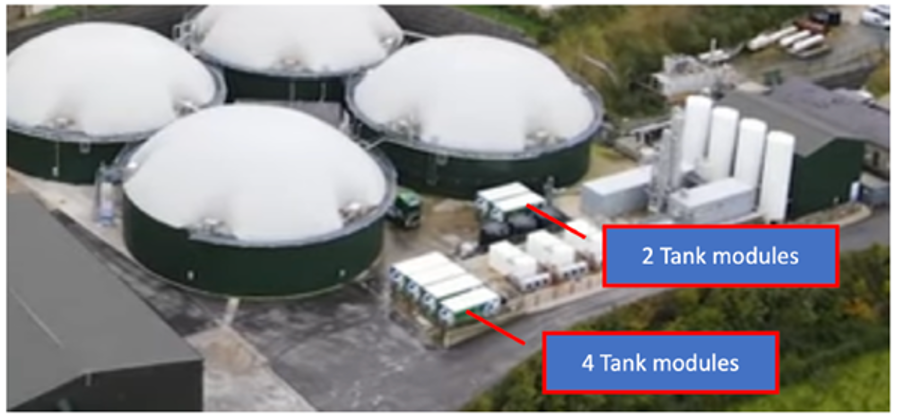
Figure 2. Six compressed gas storage tanks at the Glenmore Generation limited. (Source: Youtube promotional video: ‘Behind the Scenes on our Biogas Operation’).

The Gort Biogas Concerns Group contacted Donegal County Council in March and submitted an enforcement complaint as this storage is contrary to planning applications at the Glenmore plant.

If people are to embrace this technology, then they need to trust the process. People need the reassurance that the decision making and planning process has been conducted thoroughly following environmental law and planning regulations – Ciaran O’ Donnell

Further investigations

From our investigation, we have identified serious issues within both planned and operational Biogas plants. This begs the question; how many of the current operational Biogas plants on the Island of Ireland are in breach of this and other regulations? With the Governments drive for a further 200 plants, what else will emerge?

This investigation highlights the cavalier culture of developers, consultants and operators to enable developments, come what may, in pursuit of profit.  Glenmore Generation Biogas is not adhering to Irish and European COMAH regulations for health and safety, and is potentially storing three times more compressed gas than it was regulated to do so. This is not about planning though; this is about the health and safety of the people working on the site and the people in the surrounding community. 

Donegal has already suffered a horrific gas explosion in Creeslough in October 2022, so Donegal County Council and the HSA will likely be hyper-vigilant to this blatant disregard of health and safety regulation.

It is clear that, for people to have confidence in this technology, then they need to trust it. For new planned Biogas plants, the emphasis is on An Bord Pleanála and local planning authorities and the HSA to ensure safety regulations are adhered to, and planning law followed.

Is it time for a full health and safety review of all current operational Biogas plants in Ireland ? Would it be prudent to establish government regulation and not guidelines for all new and existing anaerobic digestors as part of the Biomethane strategy ? We certainly think so.  

We look forward to a timely response from Donegal County Council and the HSA in regards to our submissions.

The Gort Biogas Concerns Group has been consistent throughout; the use of anaerobic digestion can help to reduce our reliance on fossil gas, when sized and scaled appropriately to the needs of the local community. Putting the needs of communities ahead of industrialisation and profits, and ensuring the safety of people and the environment is paramount.

David Murray, Gort Biogas Concerns Group

Featured post

National Biomethane Strategy slammed by An Taisce

At the end of May 2024, the Government released a National Biomethane Strategy which has come under fire from a key environmental organisation – An Taisce.

The National Biomethane strategy

The National Biomethane Strategy launched on 25 May 2024 to produce up to 5.7 TWh of biomethane by 2030, reducing reliance on fossil gas and contributing to Ireland’s Climate Action Plan by adding about 200 anaerobic digester plants. The strategy specially calls out the use of waste such as ‘grass’ to be used for alternative land use options and income diversification for farmers. The government has sought €40 million to provide funds for a Biomethane Capital Grant Scheme for early adopters. The scheme will be administered by the Department of Agriculture, Food and the Marine in partnership with SEAI. Minister Eamon Ryan aims to expand grant support from 2026.

Credibility assessment

  • The strategy does not fully consider the environmental impacts of biomethane production, including methane leakage and ammonia pollution.
  • Potential adverse effects on climate and water quality from fertilizer use for silage growth are not addressed.

An Taisce submitted a critical review of the Irish Government’s National Biomethane Strategy, highlighting its lack of scientific and economic credibility and is criticized for not adequately analyzing the potential negative environmental and climate impacts. The following are the key points.

Lack of Comprehensive Analysis:

Regulatory Capture and Biased Consultations:

  • The preparation process favored industry stakeholders, ignoring environmental NGOs and academic research.
  • This approach raises concerns about regulatory capture and misdirection of policy supports.

Methane Leakage:

  • Methane losses from AD plants are a significant issue, potentially making biomethane worse for the climate than fossil gas.
  • Scientific assessments and field measurements indicate unsustainable methane leakage rates, which are not sufficiently addressed in the strategy.

Environmental Risks of AD Feedstock:

  • The high use of silage and slurry mix for AD feedstock could increase global warming and ammonia emissions, worsening pollution.
  • Ireland’s pasture-grazed system may not be suitable for AD biomethane, leading to pollution swapping and negating climate benefits.

Nitrogen Pollution:

  • The strategy could lead to increased nitrogen use, contrary to policy goals of reducing nitrogen inputs.
  • Strict regulation on national nitrogen use is necessary to avoid environmental degradation.

High Costs and Inefficiency:

  • Biomethane is an expensive renewable energy source compared to alternatives like wind, solar, and heat pumps.
  • The strategy fails to clarify financial benefits to the public, with potential gains skewed towards powerful industry players.

Unintended Consequences:

  • Large-scale AD biomethane rollout could lead to unintended negative outcomes, such as promoting the growth of mega-dairy farms.

Assessment from Gort Biogas Concern Group.

If the experience that we suffered in Gort is anything to go by, many communities across the nation are heading for trouble.

The plans for a mega Biogas plant in Gort were underscored by inexperienced developers and extremely poor environmental analysis. Novice mistakes in calculations, huge holes in the environment analysis highlighted by our group and supported by Galway County Council. For instance: the EIAR for the Gort Biogas proposal submitted by Halston Engineering …

  • … had mistakes on the gas volumes of the buildings leading to lower exhaust rates giving the impression of lower air pollution.
  • … neglected to consider Biogas as a flammable/ explosive – basically all the biogas in the 12 domes. See what happened here when lightening stroke a small digester plant in Oxfordshire.
  • .. didn’t do detailed geological surveys even though preliminary geological surveys showed karst fissures below the planned domes.
  • .. didn’t do detailed pollution analysis based on the relative height of the stacks relative to residences on the Galway road
  • .. didn’t provide any details on digestate land spreading and impact of increasing nitrate levels.
  • … made mistakes on their traffic analysis and don’t take into account peak biogas production times.
  • … lacked proof of the sustainability of the development when considering prices for silage and transport costs.
  • … didn’t properly regard the proximity of the Gort River to the site
  • … didn’t address water needs properly.
  • …. And many many more ….

We were of course very concerned about the lack of professionalism and detail delivered especially when our community and environment were at stake. It was a sigh of relief that Galway County Council came to the same conclusions and refused planning permission. The real surprising concern was when An Bord Pleanala based on what we felt was a developer-biased report and despite the real issues outlined by ourselves and the Council overturned the Council’s refusal and gave permission for the plant. This of course led to the community having to bring the case to the high court and eventually common sense prevailed and An Bord Pleanala conceded the case and effectively is currently is overturning their refusal.

An Bord Pleanala was willing to really push the Biogas agenda, despite valid and key concerns – why?? This was a railroading of the Biogas agenda long before this ‘strategy’ which will no now be used as a leverage to justify Biogas development for over 200 plants.

Conclusion:

An Taisce are correct, in that this was really a developer/industry driven strategy. This is similar dynamic to what we have already experienced in Gort where we felt the proposal was shoehorned for national strategies regardless of actual and real impacts to the community and environment.

An Taisce is urging a significant revision of the Draft National Biomethane Strategy to incorporate input from environmental NGOs and peer-reviewed research, ensuring that known issues with biomethane production are effectively addressed to avoid exacerbating climate and mitigate environmental impacts. Gort Biogas Concerns Group fully support this.

The policy missed a chance to really enable smaller-scale digesters that would fit within current farming densities and infrastructure rather than enabling these mega-biogas facilities in areas that are not suitable.

In a report in the Report in the Farmers journal also criticised the strategy stating it has missed an opportunity .

We had an opportunity to develop a new industry from the ground up-one that could be farmer-owned and support a fair and just transition. Instead the states lacklustre effort has made it nearly impossible for farmers to own this industry.

Farmers Journal, Saturday 1st June.

What happened in Gort will no doubt be repeated, especially as our Government is waving money around to attract developers to fast-track Anaerobic digester developments – and with their subsequent ‘greenwashing’ they will in no doubt continue to discard/dilute real environmental impacts.

If our highest planning authority, An Bord Pleanala, overturned a local council planning decision to grant a mega-biogas plant close to a thriving rural town, in an extremely environmentally-sensitive area based on a dismal EIAR, then nowhere in the country is safe from these mega plants.

The national biomethane strategy is a good example of greenwashing – painting the picture of a benign ‘green’ tech without taking consideration of serious community and environmental impacts

The Waiting Game continues

What’s going on with our case….?

Essentially, we have no news since our last update, and we continue to wait for a decision from ACP (formally ABP).

Those of you following progress will remember that we won our case at the High Court in August 2024. However, this wasn’t clear-cut. The developers then applied to the court for remittal. In short, this meant the developers were granted leave to have the case sent back to ABP for another review. This means a new inspector, a new report and a new decision by the board.  What a waste of time and resources.

So essentially, since August 2024, we have been waiting for news from ACP. We remain in regular contact with ACP, but nothing new to report.

In short, we could get a call tomorrow or in 12 months; we simply cannot say it’s entirely out of our control.

What happens next….?

Once we receive notification from ACP, we can plan our next move, until then, we wait. If the decision goes in favour of the developer, then we need to mobilise quickly. The community war chest provides us with the ability to respond quickly and without delay.

If the decision goes our way, then common sense will have at last prevailed. The community will then decide the next move, as agreed at our last public meeting in January 2024.

Strengthening our case

While we await a decision from ACP, we have been working in the background to increase our presence nationally and at EU level. This has been achieved through the formation of the National Biogas Concern Group Ireland (NBCG) and the gathering outside Leinster House in June, as previously reported here.

Here’s a flavour of what else we have been doing to strengthen our position:

  • November 2024. Gort Biogas Concern Group (GBCG) contributed with a “community perspective” piece to an EU-wide publication by a European NGO launched in Brussels in November 2024.
  • February 2025. The formation and launch of the National Biogas Concern Group Ireland (NBCG)
  • June, 2025. GBCG joins an EU multi-partner coalition group opposed to the rapid growth of Biomethane across Europe. The coalition produced a booklet entitled Stop the Biomethane Rush that was presented to ministers at Leinster House by the NBCG.
  • September 2025. GBCG was contacted to contribute to a research project conducted by an Irish University, as part of a wider project to evaluate the environmental, social and economic impacts of bioeconomy/bioenergy projects in Ireland.
  • October, 2025. The European Biogas Conference was recently held in Brussels (13-17 October). One of the tabled events was a panel discussion on “how biomethane is empowering communities”. A little ironic given our predicament. GBCG requested a place on this panel discussion, and of course, were refused. But they now know who we are.
  • October, 2025. The NBCG group presented at the Oireachtas Committee on Anaerobic Digestion, hosted by the Joint Committee on Agriculture and Food. The group presented the case of why it is vital to have dedicated planning regulations in place for large-scale Biogas developments and why community engagement is critical to this process. You can watch it here (opening statements begin at 44:40) and part 2 here.

So, while we await our fate, we have been busy strengthening our campaign, and we will continue with our community mandate until the threat has passed.

Have we missed anything….?

We have always operated on a Fact not Fluff policy, so when we have an update, the community will always be the first to know. GBCG is made up entirely of volunteer effort, so we keep our powder dry until we have something important to say.

If we have missed anything or if you have any other questions, we are always available, just ask. You can stop us on the street, or if you prefer, contact us directly by email at: biogasconcerngroup.gort@gmail.com or by messaging us through our Facebook page

Thank you for your untiring and unwavering support!

A harmonised voice – National Biogas Concern Group Ireland

Since 2019, the people of South Galway have stood united against the proposed construction of an industrial-scale biogas plant in Gort, Co. Galway. What began as a small but determined group of volunteers from the Gort Biogas Concern Group (GBCG) has grown into a community-driven campaign. Backed by unrelenting local support, the group has taken its fight all the way to the High Court via a judicial review of An Bord Pleanála’s planning approval.

Compare this community-led effort to the power of international agri-business investors, well-funded and backed by professional consultants. It quickly becomes clear how easily small communities can be marginalised and bulldozed by corporate interests without the support of statutory planning regulations.

A turning tide

Over the years, GBCG has assisted other community groups facing the same daunting situation we faced. These groups have in turn assisted others with their campaigns, and together using our shared experiences and knowledge we have been able to build a stronger, more coordinated response. Seven community groups across Ireland now use the moniker Biogas Concern Group, and several more exist under different names.

A harmonised voice

The need for unity saw the formation of the National Biogas Concern Group, a coalition providing a strong, harmonised voice in Ireland in response to the poorly regulated biogas boom. Led by members of the Swinford Biogas Concern Group, the NBCG mission is straightforward:

The National Biogas Concern Group, Ireland, champions the safeguarding of the environment and supports renewable energy projects that are fair and respectful of rural residents, wildlife, natural resources, and European law. We advocate for binding planning regulations for anaerobic digestion (AD) developments that ensure rigorous environmental protections, genuine community involvement, and appropriately scaled, circular bioenergy systems sited at safe distances from homes and proper road infrastructure.

The EU perspective

The National Biogas Concern Group is part of a wider European movement through our collaboration with Foodrise, a coalition that highlights the risks of the ongoing biomethane rush.

Although the biogas industry is more established in other EU countries, significant mistakes have been made. Ireland, still in the early stages of this industry, now stands on a precipice. Without strong regulation, we are poised to repeat those same mistakes, chasing unrealistic production targets at the cost of our environment and local communities.

We have already experienced breaches of planning and environmental law from existing biogas plants in Ireland due to poor regulation, monitoring and enforcement. The government’s National Biomethane Strategy aims to build 200 more biogas plants by 2030.

Leinster House – a chance to voice concerns to policymakers

National Biogas Concern Group, will meet outside Leinster House on the 11th of June 2025, to voice concerns to our elected representatives about the lack of statutory planning regulations in the face of the biogas boom.

The long and winding road

In late April 2018, a planning notice appeared on Kinincha Lane, nothing big or obvious, just a regular notice that you might see for a new house build. But this notice was different, its purpose was to inform the public that planning was sought to build one of the country’s largest biogas plants within shouting distance of the town square. What could not be foreseen was this marked the beginning of a long-running battle that would ignite the community.  The news of this new development was raised at a public meeting of the Burren Lowlands group and was met with genuine shock and surprise. How could a development of this scale reach planning and yet no one knew about it? Something was amiss. Several county councillors present at the meeting were aware of the development and were able to provide some additional details, but people were left wanting. The developers were faceless and, in the shadows, so a collective was formed to gather information.  In doing so the seeds were sown for the Gort Biogas Concern Group (GBCG), a group made up of volunteers with a simple remit; to inform the community and raise awareness about this dodgy development.

Once out in the open, news quickly spread, along with a rising tide of opposition. The new group had to work fast to be able to critically review the planning application. This was a steep learning curve. More volunteers joined the group, spreading the load. The first public meeting was held on the 17th May 2018 in Sullivans Hotel. Several hundred people attended and the message from the community was loud and clear; this development was not wanted. The size, scale and location of this plant would negatively impact all aspects of life in Gort and bring no recognisable benefits for local residents.  This wasn’t a collective case of NIMBYism (Not In My Back Yard), but genuine concerns, voiced by the community. Public information clinics were organised and over 140 objections were lodged with Galway County Council. The County planning office requested extensive further information from the developers, with a six-month deadline in which to respond. Six days before this deadline, in December 2018, the developers withdrew their planning application. The community breathed a sigh of relief, a battle was won, but was this the end?

Throughout 2018, and with the threat still looming, people began to take stock and appreciate what their local surroundings had to offer. None more so than the Riverwalk group, under the helm of David Murray. Little did we know how important this much cherished local amenity would become in the years to follow. It’s often joked that some of the credit for the Riverwalk should go to the biogas developers, so well done lads!

In November 2019, the developers lodged a new planning application, not too dissimilar to the first, but with the main entrance now located on the old Galway Road. The community rallied with renewed vigour, and a public meeting was held in Sullivans Hotel on the 10th of December, with several hundred people in attendance. Information clinics were held in Gort and Kinvara, and over 400 objections were lodged. In January 2020, Galway County Council refused planning. Another battle had been won, but we knew we were not out of the woods yet.

In February 2020, the developers lodged an appeal with An Bord Pleanála (ABP) against Galway County Council’s decision. A third public meeting was held on the 10th of March in Sullivans Hotel. With the country on the cusp of Covid lockdown, we faced another battle, while our daily lives were in turmoil. This was a gear change for the campaign, as we were now in the national arena, going head-to-head with the state’s independent planning body, ABP. Unable to meet up physically, the group was meeting weekly online to keep the momentum going. With a strong technical review team in place, GBCG submitted a detailed 54-page report to ABP including, over 1,000 petition signatures as well as a significant number of independent submissions. Over the next 10 months the case moved between ABP and the high court. Not privy to actions going on behind closed doors, our only means of keeping track was through the diligence of one of the group, who phoned ABP every week without fail. From these calls, it was gleaned that in late June ABP decided that the developer’s appeal was invalid as it was lodged after the deadline. This led the developers to lodge an appeal case in the high court. A judicial review was granted by the court and the developer won the resulting case. The upshot; the developer had another opportunity to lodge an appeal with ABP, effectively taking the case back to the beginning.  On 17th December 2020, the developer lodged a second appeal with ABP. With no opportunity to hold a public meeting, the campaign moved to social media and other creative ways to get the message out to the community. GBCG resubmitted the technical report and extensive petition in time for the 22nd January 2021 deadline. ABP advised a decision would be made by 30th April 2021.

During spring 2021, it wasn’t only the daffodils that were blooming but also the anti-biogas signs, posters, prints and car stickers around the south Galway. This led to a welcome wave of colour around Gort as well as a renewed injection of support. Having suffered the grounding effects of multiple lockdowns, our local environment was now appreciated more than ever.  

The ABP April 30th decision deadline came and went, and another response date was set for the 24th of June.   The June deadline also passed and no new date was set, leaving the community in limbo. Throughout the pandemic, the group managed to keep the campaign alive, and relevant, through the incredible efforts of the communications team. Through this effort, Gort was now in contact with several groups across the country in the same predicament. The plight of Gort had attracted the attention of local and national media outlets.  All the while the government was pushing forward with the green initiative through the national biomethane strategy. The GBCG has been consistent throughout; this technology is proven, and biomethane can help to decarbonise our economy, albeit in a relatively small proportion compared to other sources. For biomethane to be successful, developers must engage with affected communities to ensure facilities are scaled and located properly, and the benefits to the affected communities are clearly defined.  Placing the burden of industrial-scale biogas plants on small rural towns could see enormous profit potential for a few faceless investors, while the impact would be suffered entirely by local communities. This is an all-too-common scenario as applications continue to sprout across the country. The potential to make massive profits from waste, under the green flag, is one investors are keen to pursue. 

As 2021 drew to a close, the campaign was no further down the road, with no decision from ABP. The only trickle of information was from the weekly calls to ABP. Regardless, on New Year’s Day, 2022, a large group attended a community walk to the biogas site, complete with music and drums, a clear indication that the spirit of the community remained steadfast. Five months later, in May, ABP requested further information from the developer in regards to the amount of water the plant would require to operate, and where this water would come from. The group, having spent countless hours running over the planning application in fine detail had found that the numbers simply didn’t add up. It was clear this development could not be viable given the details provided. It was hoped, with the ABP request for further information that, ABP would come to the same conclusion. Autumn came and went with no updates.

On the 22nd of December 2022, after almost two years, the news came that ABP had granted permission for the development to go ahead. An unexpected thunderbolt. We now had until 22nd February in which to respond. We were fully aware this was our last chance or development would go ahead unchallenged. Action stations! Our now infamous public meeting was held on the 5th of January 2023 to raise the funds to mount our legal challenge. The goal was to challenge the decision of ABP by way of a judicial review and to have the decision overturned. This was by far the group’s biggest challenge and a challenge on multiple fronts. Within seven weeks we needed to find and secure a legal team to represent our case. Coordinating fundraising activities and fund management was critical, and we had a great team already in place to do this. From a technical aspect, a critical review of the ABP inspector’s report was required, and to do this we needed the help of external expert consultants. 

Under advice from our legal team, and in light of the government’s proposed Planning and Development Bill, we joined forces with the Burren Lowlands Group (BLL) to further strengthen our case. In doing so we closed the loop from where we started back in 2018 where BLL was first alerted to the development. The race to the finish line was tense, with papers still wet with ink being rushed up the motorway to Dublin to be filed before the court.

Throughout the spring, court dates were set, then adjourned, and the process repeated until we were granted leave to appear and then a Judicial review (JR).  A JR investigates the process by which a legal decision is made, and if the process has followed the letter of the law. Now we were solely reliant on our legal team to pursue this on our behalf. Court dates were set and then adjourned, as before. The process continued until, completely out of the blue, on the 21st of November 2023, ABP decided to concede the case. Their legal team decided they could not win the case and would cut their losses. This was a massive win for Gort. In January 2024, a public meeting was held to update the community on the news and to develop a community-led plan for the future.  It took several more months in the court for the decision of ABP to be officially overturned and the case was formally quashed. 

So where are we now? As of August 2024, the developers were granted remittal by the high court. The judge chose to bring the case back to ABP for review. A new inspector will be appointed and a new report issued to the ABP board for consideration. We are effectively back to where we were in February 2020. As daunting as this may sound, we are starting from a much stronger footing than before. GBCG submitted a highly detailed observation document, ahead of the deadline, updating the Board with the information relating to the many changes in Gort since the previous case ABP. So, as we ready ourselves to enter the battlefield again, we remain undaunted and undeterred.

The people of Gort have moved on in their thinking, setting their collective sights instead on a future with sustainable growth in mind, a place where people will want to live and work, and a place that values its local environment. These goals, developed through extensive public consultation, have been distilled into the Gort Town Centre First Plan. The Gort Town Centre First Plan does not include an industrial-scale biogas plant and indeed identifies it as a clear threat against the delivery of the plan. GBCG has a clear mandate from the community and will continue to represent the people of South Gort for as long as required.

For more information, please follow us on our Facebook page (Gort Biogas Concern Group) and visit our blog (Gort Biogas Concerns) for some interesting articles.  

A significant battle won, but the war continues

A significant win

The people of south Galway remain jubilant after their recent victory against An Bord Pleanála (ABP) during a Judicial Review in the High Court. Gort Biogas Concern Group and the Burren lowlands jointly took this action against the flawed decision of ABP to grant permission for the developers to go ahead. The legal case was funded entirely by the community and local businesses. From receiving the news in 21st Nov 2023, it took until late March 2024 for the case to be officially concluded, ending our successful Judicial Review against ABP. We will seek to have the recoverable portion of our legal costs returned to the campaign. This was a significant victory for the campaign against the national planning appeals board.

Another battle looms

The developer (not involved in the JR case but a notice party) has been granted remittal by the High Court. This means that they, the developer, does not need to restart the planning process. Instead, they can ask ABP to reconsider the same application again. One of the key points that ABP conceded on was the road realignment at the entrance of the site. Access to the site, as outlined in the application, was from the old Galway Road (R458), this road is a restricted regional road. Creating access for development of this nature onto a restricted regional road contravenes planning law. The developer is now back trying to argue the same application again with ABP, faults and all.

We are now waiting for ABP to contact Gort Biogas Concern Group, Burren Lowlands and all those who sent in observations. They must inform all parties that the application is again back on the desk of ABP. How long will this take? We don’t know. The wheels of planning law are slow, but our community is on its feet and ready for another battle.

Are we deterred? Not at all, we are in a significantly stronger position now than we were back in 2020 when the case first appeared before ABP. Are we frustrated? Yes, but we remain steadfast, with a clear mandate from the people of south Galway, underpinned by the full support of our elected representatives. We have a war chest raised by the community and this will be put to work to fight any battles that come our way. We will continue in our efforts to deter the developers from being able to create any kind of foothold in this area and we have a few things in progress and we hope to update you soon !

Thank you for your ongoing support,

Gort Biogas Concern Group

ABP concedes the Gort Biogas case – a win for Gort and South Galway

A case brought to the High court by the Gort Biogas Concern Group CLG and the Burren Lowlands CLG against the decision of An Board Pleanála to grant permission to build an industrial scale Biogas Facility in the town of Gort has reached conclusion, with An Board Pleanála conceding.

The case is the culmination of five-year campaign fought by the people of South Galway against this development, and has been received with great joy by people from the town. Gort Biogas Concern Group member Ciaran O’Donnell said “this is a win for common sense, industrial developments of this scale belong in industrial settings. Galway County Council got it right, and refused planning, it took ABP a bit longer to reach the same thinking, and we had to fight it all the way”.

Gort Biogas Concern group, composed entirely of volunteer effort, raised the funds from donations from the community to mount the legal challenge. The group has been clear from the onset that there is a place for Anaerobic technology, if scaled to the local area and with local needs considered. Industrial developments of this scale would financially benefit a few individuals but impact everyone living in or visiting the town. The scale of the proposed plant matched the size of our neighboring town of Kinvara and would be located just 800m from Gort’s town square. The potential impact on the environment was too great given the importance of local area and karst landscape, feeding into the pristine Coole-Garryland SAC complex. The long term viability of the town was also at stake, being unable to realise the full potential of local heritage and to capitalise on its position in the Burren Lowlands. The people of Gort support a vision of long term stability and viability, driven by input and engagement.

O’Donnell continued “the unrelenting and endless support of the people of south Galway made this happen and we will remain vigilant for this and other such similar developments that threaten the local environment and the viability of the town to thrive and prosper into the future”.

Gort Biogas Concern Group Legal Challenge Update

The people of south Galway have shown incredible generosity over the last few weeks through donations and fundraising activities. We are making good progress towards reaching our target funding to pay for our legal challenge against An Bord Pleanála.

Since receiving the notification from ABP in late December and incredible amount of work has been going on in the background to forensically review all aspects of the ABP report and to build our case.   

Legal Challenge progress

Our legal team is in place and are busy putting together our case. They are working towards a deadline of the 24th February, by which time we must submit our complete case before a judge for review. The judge will then decide if we have sufficient grounds to proceed. Once we do, then the same amount of time, roughly 8 weeks, will be offered to ABP to prepare their defence case.

The judge will then be set for the case to be heard in court.  

Time line

  • By the 24th February our legal team will have submitted the case to the High Court for leave to appeal.
  • If and when leave to appeal is granted, the judge must then offer the same amount of time (circa. 8 weeks) to the defendant to prepare their rebuttal.
  • The judge will also appoint a date for the hearing in court. This can take anywhere from 2-8 months. The length of time is difficult to estimate as extensions are invariably sought during the case. The court diary will also be busy. As always we will keep people informed as we are all fighting this together

So what’s happening right now….?

Right now we are continuing to fundraise and have some really great events coming down the track this Spring, including some fun at the St. Patrick’s Day Parade.

Keep an eye on our FB page (https://www.facebook.com/gortbiogasconcerngroup) and soon to be live Instagram account (https://www.instagram.com/gortbiogascg/) for updates and more information.

The message remains loud and clear

The people of south Galway do not want this development and will take the fight as far needs be to ensure the protection of our town, its people and our local environment.

Ciaran O’Donnell

The Planned Biogas Plant in Gort – An explainer

After almost a 2 year wait,on the 22nd of December, An Bord Pleanala decided to overturn Galway County Council’s decision to refuse planning permission for a large-scale Biogas plant on the immediate outskirts of Gort Co. Galway. This decision will have brutal impacts on Gort town and the local environment as the Biogas plant is set to go ahead.

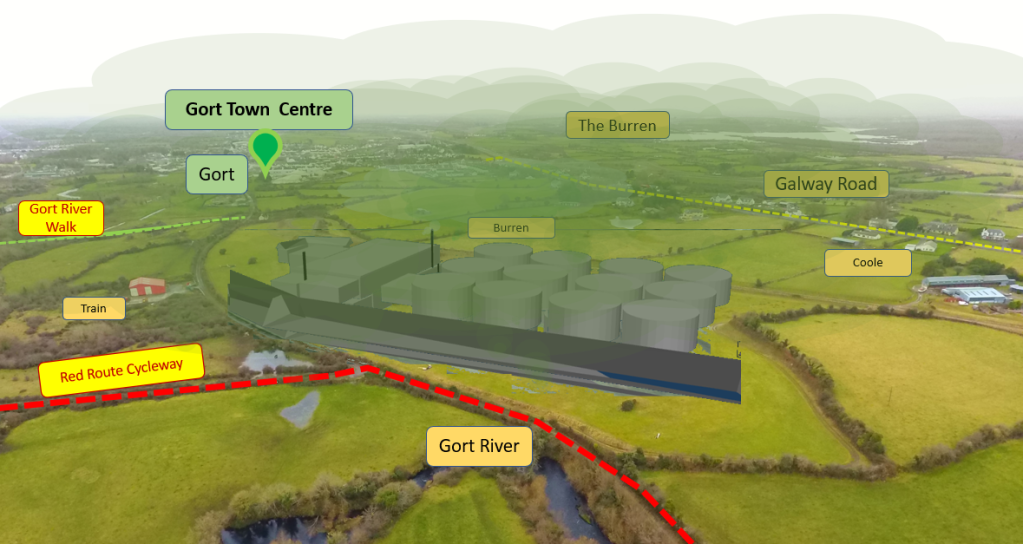
This industrial biogas plant (think of it as a massive stomach) , will be developed on a 25 acre site. The town of Kinvara could fit inside it. It will have the following process

  • Take delivery of 90,000 tonnes/year of ‘feedstock’ such as slurry, food compost, fish waste and silage
  • Digest this in 8 massive digester tanks and produce Methane, Carbon Dioxide and other chemicals such as Hydrogen Sulphide, Nitrous Oxide , Ammonia etc
  • This process will produce offensive odours within the process
  • Store and export 150,000 tonnes/annum of the digested slurry or digestate
  • Spread this on land in vicinity of the plant – This equates to spreading almost 2 Olympic- sized swimming pools of smelly slurry-digestate on land in South Galway/North Clare every week.

Anerobic digesters are a key part of our Climate Action Plan but there are some key issues that we have in this location.

  • The location is completely wrong for an industrial sized biogas plant, in terms of it’s access to feedstock, size and proximity to local population, local amentities and its proximity to Coole Park nature reserve and SACS, These should be located to feedstock sources.
  • There are key health concerns for locating this facility so close to a town (100m to nearest residence, 50m from Gort River Walk, 400m to nearest housing estate and 900m from Gort Town Centre/Square). Biogas plants produce Nitrous Oxide, Ammonia, Sulpher Dioxide many of which are harmful to human health. Biogas plants can explode.
  • There are traffic, and health and safety concerns as this facility will bring 6,000-7000 HGVs into Gort per year. This may cause havoc on the towns roads, increase risk of traffic accidents and bring more fumes and noise into the town
  • This will make town and environs smelly – from escaped odours of the plant to the spreading of 2 olympic-sized swimming pools of smelly digestate per week. This will have the most pervasive and impactful effect on the town e.g.
  • The town and and local economy will be severely impacted – tourism will plummet – accommodation, restaurants, services. House values will plummet. People will not want to live or locate their business in town. The culture of the town will be forever changed. Welcome to ‘smelly Gort’ and
  • The local environment will be at risk. An explosion or spill into the Gort River (10m from plant) will reach Kitartan and Coole Park and would have catastrophic impacts. Digestate on land will increase levels of pollution in South Galway
  • The plant could suck Gort Town dry of water. Our fragile water system couldn’t take heavy water demands from this type of plant. The town supply is at near critical level and the infrastructure simply isn’t there to meet the additional demand of such a facility.
  • There are national rural concerns here also because these plants will try and locate themselves close to infrastructure and they won’t take local towns concerns into consideration.

The community around South Galway is devastated that after all the work done and Galway County Council’s refusal that this is being allowed to go ahead and deal a horrendous blow to the future of Gort and South Galway. The general consensus of the South Galway community is that if this development goes ahead it will absolutely ruin the town and surrounding environs and have impacts on peoples lifestyles, health and businesses around South Galway (especially the tourism industry)

Please help us protect it now and into the future. Please support or fundraiser to mount our legal challenge to overthrow An Bord Pleanala’s decision to grant planning permission.

Sustainable Bio-Energy Limited…. the numbers still don’t add up

An Bord Pleanála (ABP) recently requested further information from Sustainable Bioenergy Limited on their proposed development of a Biogas plant in Gort, Co. Galway. The ABP requested focused on the water requirements to run this facility, where this water would be sourced from, and how these numbers were calculated.  The water requirement, as stated within the application, is 120,000,000 litres per year (120,000 m3).  

The ABP request…

“Please provide a breakdown of the water/liquor supply sources to be utilized at the proposed development with the associated calculations which confirm the availability of water/liquor capacity to meet the statement requirement of 120,000 cubic metres of liquor per annum as outlined in the application documentation (Appendix 7.2 – Stormwater Report – of Volume 3 of the Environmental Impact Assessment. “

An Bord Pleanála, Further Information request

Sustainable Bioenergy Limited (via Halston) responded to on 3rd June 2022. Here we delve a little deeper into the numbers from the original application.

Let’s start at the beginning….the Gort water supply

For the last five months Gort has endured a boil water notice. Thankfully we are at the end of this long and drawn out process now and ‘normal’ service has resumed. A clean water supply is a precious commodity most of us fail to recognise until we have to sit up and pay attention. Aside from the inconvenience to most, the affect hit the more vulnerable members of our community the hardest. The underlying issue here is that the towns water supply is in a precarious position; ‘highly sensitive’ and in ‘severe crisis’, not my words, but those used in recent Dail[1] discussions about the Gort water supply.

The Gort water supply is currently close to maximum capacity and even a modest increase in demand will require significant improvements to the network. To give an understanding of capacity sensitivity, according to the Irish Water Capacity Register, in dry summers the Gort Water supply is barely able to keep up with demand. The total capacityofthe current Gort water supply is 1,440 m3 /day and the summer of 2019 saw a daily usage of 1,407 m3/day.  This doesn’t leave much of a margin before things become critical.  

Water requirements for the proposed Gort Biogas plant

Starting up a biogas plant requires feedstock and water to create a Liquor to start the Anaerobic Digestion Process. The amount of water required is dependent on the type of feedstock used and the amount dry-matter content (DMC) it contains. The water requirement calculations shown in Table 1 are based on a median 7% dilution rate, whereas actual ranges are from 5%-8%.

Table 1. Sustainable Bioenergy Limited proposed feedstock material, tonnage and water requirements for dilution.

FeedstockAnnual TonnageDry Matter Content (DMC)DMC (Tonnes)Water Content (m3)Water Required for Dilution to 7% (m3)
Grass Silage54,00028%15,12038,880162,000
Cattle Slurry22,50011%2,47520,02512,857
Agri-Food Residues13,50012%1,62011,8809,643
Total90,00019,21570,785184,500

Water requirements to meet the minimum (8%) and maximum (5%) ranges are shown in Table 2.

Table 2. Water dilution range, potential dilution requirements

DMC of digestate in digestersWater Required to Dilute Feedstock (m3 per annum)
5%294,300
6%230,250
7%184,500
8%150,188

Rain glorious rain

Sustainable Bioenergy Limited state in the EIAR that they will source all of their water requirements for the digesters from rainwater. A standard connection to the Gort water supply is included to meet building supply needs (offices, toilets, etc). Based on their own information (supplied via Halston), the plant will source most of their feedstock material from Grass Silage. This will see peak water demand during the driest months of the year.

Worth stating again…. Peak demand period for rainwater will be during the summer months when we have the least rain. The numbers provided by do not take into account the seasonality of rainfall and assume it rains equally each month of the year, throughout the year!

Whichever way you cut it once again the number simply don’t add up.

As defined in the EIAR, and taking into consideration the proposed Biogas plant feedstock inputs, process and digestate outputs there will be a significant shortfall in water supply for the plant. There is a significant lack of detail applicant’s response when it comes to water supply and demand and this simply isn’t good enough.

ABP Request for additional information…are things clearer now?

The simple answer is no. Ample opportunity was provided to address the information requested by ABP. However, all the remains is uncertainty.

“Please provide a breakdown of the water/liquor supply sources to be utilized at the proposed development with the associated calculations which confirm the availability of water/liquor capacity to meet the statement requirement of 120,000 cubic metres of liquor per annum as outlined in the application documentation

Table 3. Water demand requirements included in the original EIAR submission and if clarification has been provided in the response to ABP.

Water DemandFigures Supplied?Demand calculation clarified?
Office (kitchen toilet) for 20 people & Laboratory + 20+ truck driversNo, but potentially part of connection to the Gort mains supplyNo
Washing of facility and trucksNo, but potentially part of connection to the Gort mains supplyNo
Production start-up SeedingNo, but potentially part of connection to the Gort mains supplyNo
Fire WaterYesYes
Anaerobic Digestion processYes – 120,000 m3No
Maintenance (annual shutdown and cleaning)NoNo

Given ambiguities in the EIAR submitted in the original application, ABP were correct in questioning the numbers provided and how they were calculated. In response to the information request, we have presented our review of their submission and have highlighted the errors and miscalculations in the EIAR, while providing empirical data on current demands on the Gort water supply, highlighting the precarious state of the Gort water supply.

We can only hope that ABP will uphold the decision of Galway County Council to refuse planning permission. South Galway already has one environmental planning disaster with the Derrybrien Windfarm and the prospect of another is unthinkable. If this plant goes ahead, you may well be reminded of this bad decision every time you go to turn on the tap. Let’s not let the well run dry!


[1]  https://galwaybayfm.ie/galway-bay-fm-news-desk/dail-hears-deep-disrespect-shown-to-gort-over-boil-water-notice-saga/

If you want to send in an observation please see instructions here: