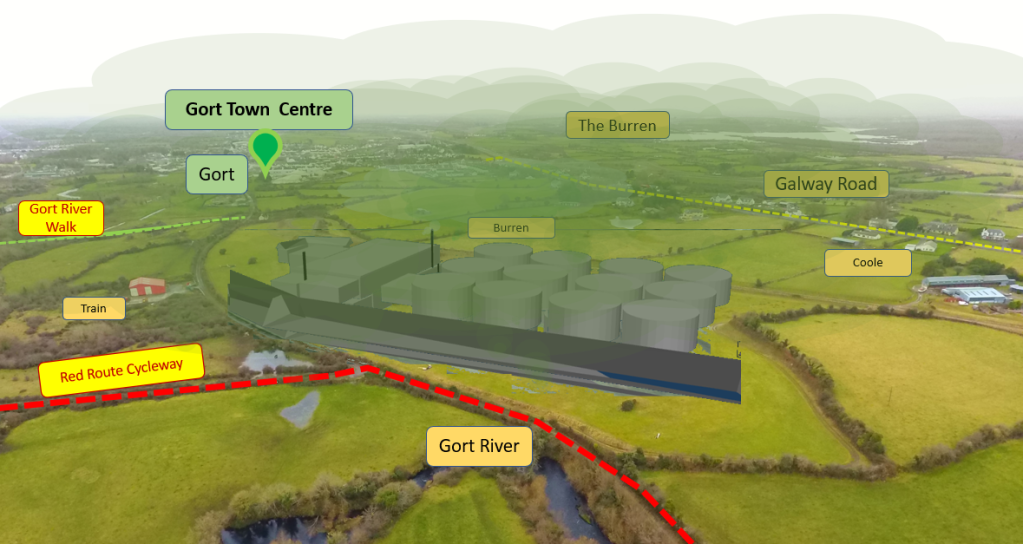
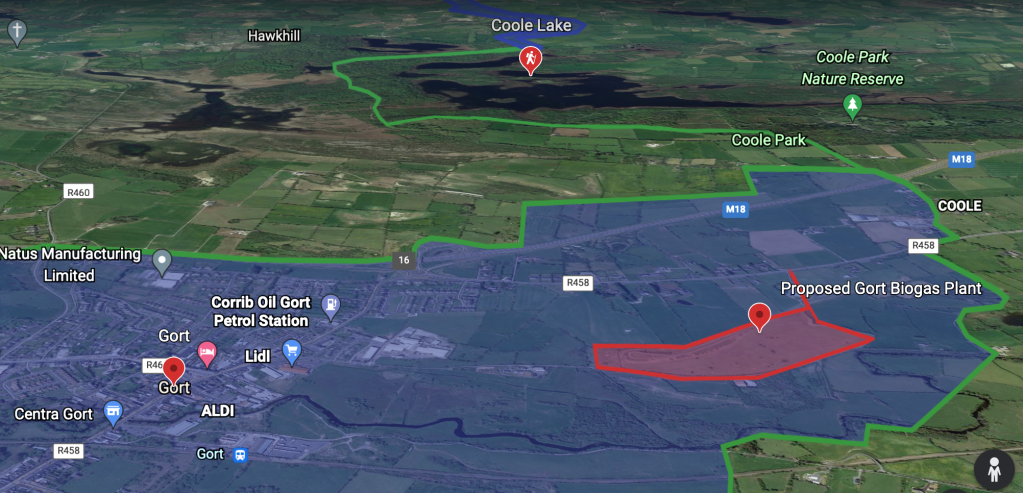
In late April 2018, a planning notice appeared on Kinincha Lane, nothing big or obvious, just a regular notice that you might see for a new house build. But this notice was different, its purpose was to inform the public that planning was sought to build one of the country’s largest biogas plants within shouting distance of the town square. What could not be foreseen was this marked the beginning of a long-running battle that would ignite the community. The news of this new development was raised at a public meeting of the Burren Lowlands group and was met with genuine shock and surprise. How could a development of this scale reach planning and yet no one knew about it? Something was amiss. Several county councillors present at the meeting were aware of the development and were able to provide some additional details, but people were left wanting. The developers were faceless and, in the shadows, so a collective was formed to gather information. In doing so the seeds were sown for the Gort Biogas Concern Group (GBCG), a group made up of volunteers with a simple remit; to inform the community and raise awareness about this dodgy development.
Once out in the open, news quickly spread, along with a rising tide of opposition. The new group had to work fast to be able to critically review the planning application. This was a steep learning curve. More volunteers joined the group, spreading the load. The first public meeting was held on the 17th May 2018 in Sullivans Hotel. Several hundred people attended and the message from the community was loud and clear; this development was not wanted. The size, scale and location of this plant would negatively impact all aspects of life in Gort and bring no recognisable benefits for local residents. This wasn’t a collective case of NIMBYism (Not In My Back Yard), but genuine concerns, voiced by the community. Public information clinics were organised and over 140 objections were lodged with Galway County Council. The County planning office requested extensive further information from the developers, with a six-month deadline in which to respond. Six days before this deadline, in December 2018, the developers withdrew their planning application. The community breathed a sigh of relief, a battle was won, but was this the end?
Throughout 2018, and with the threat still looming, people began to take stock and appreciate what their local surroundings had to offer. None more so than the Riverwalk group, under the helm of David Murray. Little did we know how important this much cherished local amenity would become in the years to follow. It’s often joked that some of the credit for the Riverwalk should go to the biogas developers, so well done lads!
In November 2019, the developers lodged a new planning application, not too dissimilar to the first, but with the main entrance now located on the old Galway Road. The community rallied with renewed vigour, and a public meeting was held in Sullivans Hotel on the 10th of December, with several hundred people in attendance. Information clinics were held in Gort and Kinvara, and over 400 objections were lodged. In January 2020, Galway County Council refused planning. Another battle had been won, but we knew we were not out of the woods yet.
In February 2020, the developers lodged an appeal with An Bord Pleanála (ABP) against Galway County Council’s decision. A third public meeting was held on the 10th of March in Sullivans Hotel. With the country on the cusp of Covid lockdown, we faced another battle, while our daily lives were in turmoil. This was a gear change for the campaign, as we were now in the national arena, going head-to-head with the state’s independent planning body, ABP. Unable to meet up physically, the group was meeting weekly online to keep the momentum going. With a strong technical review team in place, GBCG submitted a detailed 54-page report to ABP including, over 1,000 petition signatures as well as a significant number of independent submissions. Over the next 10 months the case moved between ABP and the high court. Not privy to actions going on behind closed doors, our only means of keeping track was through the diligence of one of the group, who phoned ABP every week without fail. From these calls, it was gleaned that in late June ABP decided that the developer’s appeal was invalid as it was lodged after the deadline. This led the developers to lodge an appeal case in the high court. A judicial review was granted by the court and the developer won the resulting case. The upshot; the developer had another opportunity to lodge an appeal with ABP, effectively taking the case back to the beginning. On 17th December 2020, the developer lodged a second appeal with ABP. With no opportunity to hold a public meeting, the campaign moved to social media and other creative ways to get the message out to the community. GBCG resubmitted the technical report and extensive petition in time for the 22nd January 2021 deadline. ABP advised a decision would be made by 30th April 2021.
During spring 2021, it wasn’t only the daffodils that were blooming but also the anti-biogas signs, posters, prints and car stickers around the south Galway. This led to a welcome wave of colour around Gort as well as a renewed injection of support. Having suffered the grounding effects of multiple lockdowns, our local environment was now appreciated more than ever.
The ABP April 30th decision deadline came and went, and another response date was set for the 24th of June. The June deadline also passed and no new date was set, leaving the community in limbo. Throughout the pandemic, the group managed to keep the campaign alive, and relevant, through the incredible efforts of the communications team. Through this effort, Gort was now in contact with several groups across the country in the same predicament. The plight of Gort had attracted the attention of local and national media outlets. All the while the government was pushing forward with the green initiative through the national biomethane strategy. The GBCG has been consistent throughout; this technology is proven, and biomethane can help to decarbonise our economy, albeit in a relatively small proportion compared to other sources. For biomethane to be successful, developers must engage with affected communities to ensure facilities are scaled and located properly, and the benefits to the affected communities are clearly defined. Placing the burden of industrial-scale biogas plants on small rural towns could see enormous profit potential for a few faceless investors, while the impact would be suffered entirely by local communities. This is an all-too-common scenario as applications continue to sprout across the country. The potential to make massive profits from waste, under the green flag, is one investors are keen to pursue.
As 2021 drew to a close, the campaign was no further down the road, with no decision from ABP. The only trickle of information was from the weekly calls to ABP. Regardless, on New Year’s Day, 2022, a large group attended a community walk to the biogas site, complete with music and drums, a clear indication that the spirit of the community remained steadfast. Five months later, in May, ABP requested further information from the developer in regards to the amount of water the plant would require to operate, and where this water would come from. The group, having spent countless hours running over the planning application in fine detail had found that the numbers simply didn’t add up. It was clear this development could not be viable given the details provided. It was hoped, with the ABP request for further information that, ABP would come to the same conclusion. Autumn came and went with no updates.
On the 22nd of December 2022, after almost two years, the news came that ABP had granted permission for the development to go ahead. An unexpected thunderbolt. We now had until 22nd February in which to respond. We were fully aware this was our last chance or development would go ahead unchallenged. Action stations! Our now infamous public meeting was held on the 5th of January 2023 to raise the funds to mount our legal challenge. The goal was to challenge the decision of ABP by way of a judicial review and to have the decision overturned. This was by far the group’s biggest challenge and a challenge on multiple fronts. Within seven weeks we needed to find and secure a legal team to represent our case. Coordinating fundraising activities and fund management was critical, and we had a great team already in place to do this. From a technical aspect, a critical review of the ABP inspector’s report was required, and to do this we needed the help of external expert consultants.
Under advice from our legal team, and in light of the government’s proposed Planning and Development Bill, we joined forces with the Burren Lowlands Group (BLL) to further strengthen our case. In doing so we closed the loop from where we started back in 2018 where BLL was first alerted to the development. The race to the finish line was tense, with papers still wet with ink being rushed up the motorway to Dublin to be filed before the court.
Throughout the spring, court dates were set, then adjourned, and the process repeated until we were granted leave to appear and then a Judicial review (JR). A JR investigates the process by which a legal decision is made, and if the process has followed the letter of the law. Now we were solely reliant on our legal team to pursue this on our behalf. Court dates were set and then adjourned, as before. The process continued until, completely out of the blue, on the 21st of November 2023, ABP decided to concede the case. Their legal team decided they could not win the case and would cut their losses. This was a massive win for Gort. In January 2024, a public meeting was held to update the community on the news and to develop a community-led plan for the future. It took several more months in the court for the decision of ABP to be officially overturned and the case was formally quashed.
So where are we now? As of August 2024, the developers were granted remittal by the high court. The judge chose to bring the case back to ABP for review. A new inspector will be appointed and a new report issued to the ABP board for consideration. We are effectively back to where we were in February 2020. As daunting as this may sound, we are starting from a much stronger footing than before. GBCG submitted a highly detailed observation document, ahead of the deadline, updating the Board with the information relating to the many changes in Gort since the previous case ABP. So, as we ready ourselves to enter the battlefield again, we remain undaunted and undeterred.
The people of Gort have moved on in their thinking, setting their collective sights instead on a future with sustainable growth in mind, a place where people will want to live and work, and a place that values its local environment. These goals, developed through extensive public consultation, have been distilled into the Gort Town Centre First Plan. The Gort Town Centre First Plan does not include an industrial-scale biogas plant and indeed identifies it as a clear threat against the delivery of the plan. GBCG has a clear mandate from the community and will continue to represent the people of South Gort for as long as required.
For more information, please follow us on our Facebook page (Gort Biogas Concern Group) and visit our blog (Gort Biogas Concerns) for some interesting articles.





 Gort Biogas Concerns